Bentley W12: Proper Servicing for a Serious Engine
Owning a W12 Bentley is a bit like owning a private jet. The experience is extraordinary, the engineering is remarkable, and the moment you start skimping on maintenance, it reminds you exactly what it cost to build. These cars often arrive wearing years of deferred servicing, phantom warning lights, or a turbo plumbing leak that someone hoped would go away on its own. It never does. The W12 is a magnificent piece of engineering, and it deserves to be treated like one.
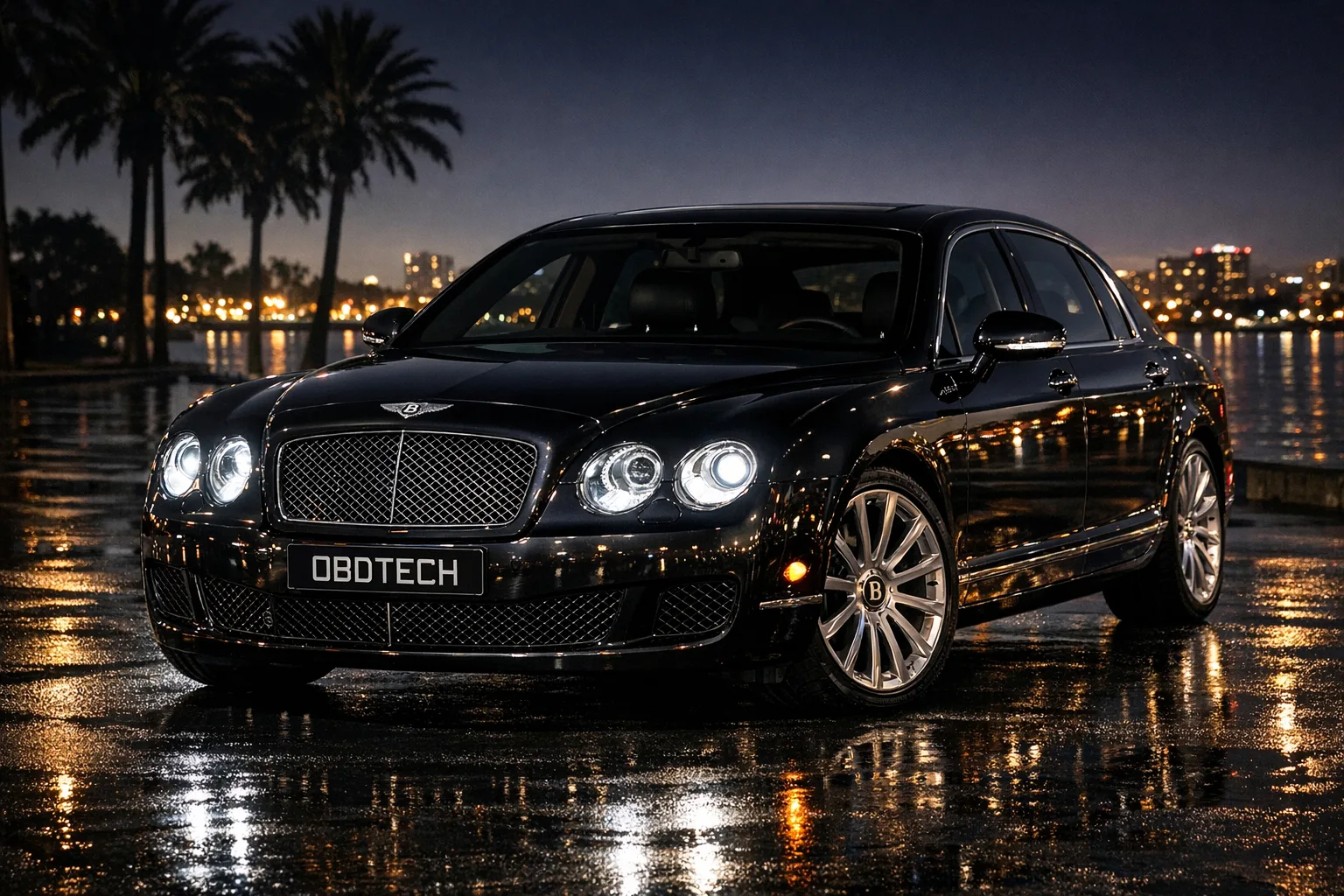
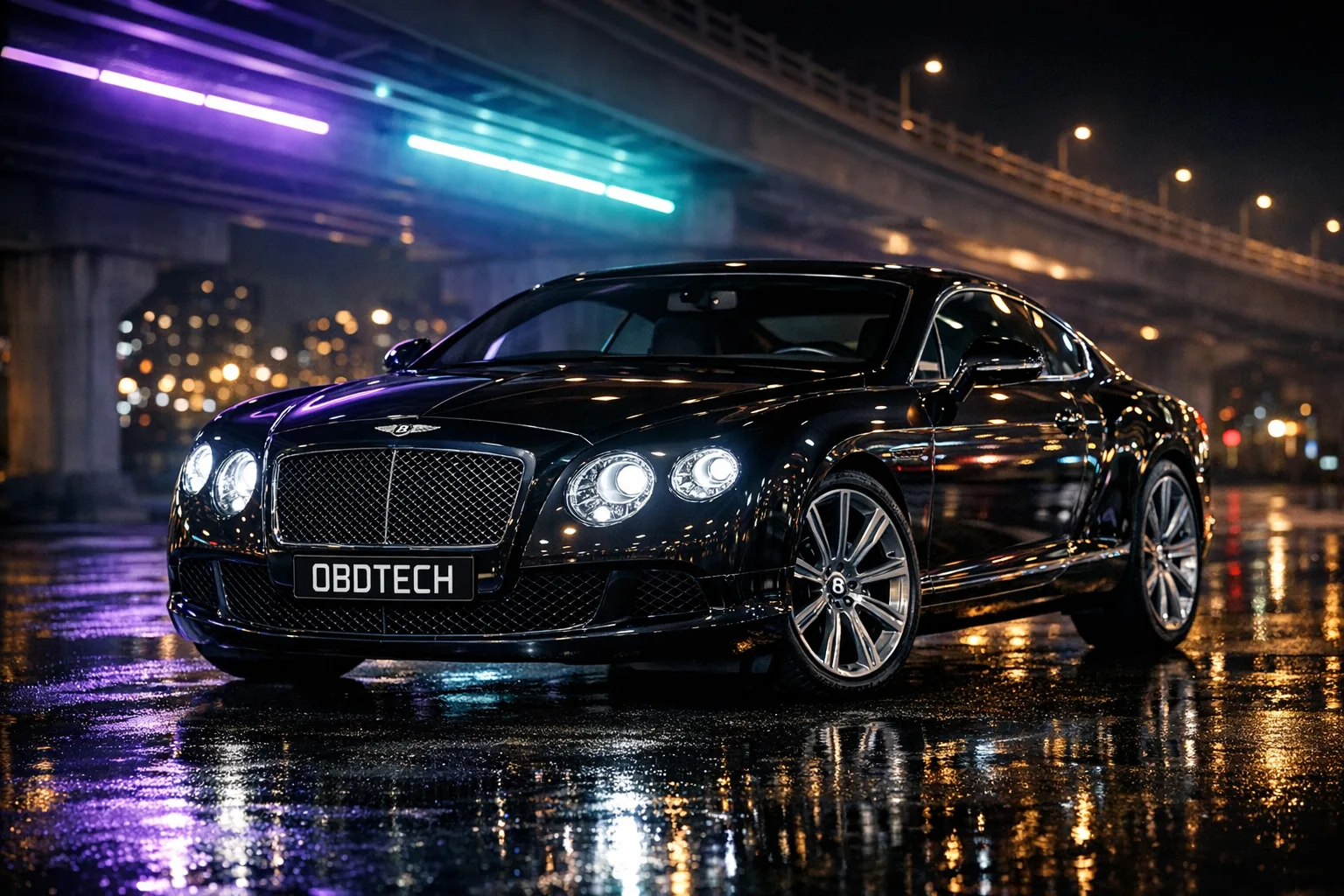
What You Are Actually Driving: The 6.0 W12 Bi Turbo Explained
The 6.0 litre W12 twin turbo engine sits under the bonnet of both the Continental GT and the Flying Spur, and across the model range it covers three main states of tune. The original BWR unit in the Flying Spur produces 560 hp and 650 Nm from the factory, running a Bosch ME7.1.1 or Bosch ME17.1.6 ECU with a 9.1:1 compression ratio and an 84.0 x 90.2 mm bore and stroke. The mid spec CVAB variant (also carrying the MTBHT designation on some builds) steps that up to 575 hp and 700 Nm, again on the same ECU platforms. At the top sits the CVA engine fitted to the Continental GT S, pushing 625 hp and 800 Nm through a Bosch ME17.1.6 ECU. All three share the same 5998 cc displacement and the same basic architecture, which is part of what makes them so tunable but also part of why the same failure modes show up across the whole family.
Twelve cylinders arranged in a narrow W configuration, two turbos, and genuine grand tourer performance targets mean this engine works harder than its effortless in cabin experience suggests. At low speeds around Auckland traffic it can run rich, build carbon, and cook coolant. That is not a criticism, it is just physics. Understanding it is the starting point for keeping these cars healthy.
-
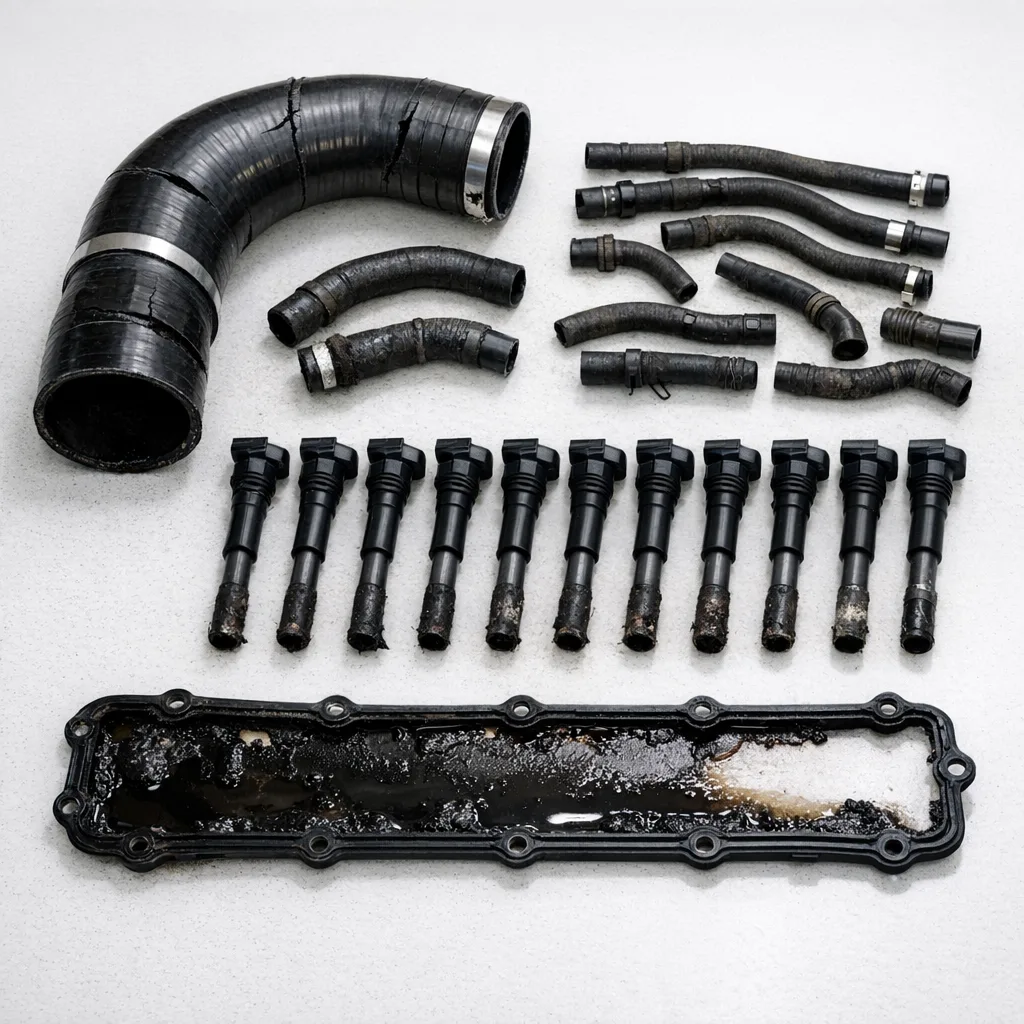
Coil Packs and Spark Plugs: Twelve cylinders means twelve sets of coil packs and twelve spark plugs. When one goes soft the ECU starts logging individual cylinder misfires. You may feel a subtle shudder at idle, a slight hesitation on acceleration, or simply see a yellow engine warning light that refuses to clear. Left long enough, a misfiring cylinder washes raw fuel into the oil and loads up the catalytic converters. Replacing a full set of plugs and coils as a matched service, rather than chasing one cylinder at a time, is the correct approach.
-
Oil Leaks from Valve Covers and Seals: The valve cover gaskets and various cam cover seals are a known weak point as mileage accumulates. The first sign is usually a faint burning smell after a hard run, or a thin film of oil weeping down the side of the engine when you look with a torch. Oil finding its way onto hot exhaust components is a fire risk and an emissions issue, and on this engine the access involved means catching it early saves a significant amount of labour.
-
Turbo Plumbing and Vacuum Line Deterioration: The intercooler pipes, charge pipes, and vacuum lines that govern boost control are largely rubber and silicone, and they age. A cracked boost pipe can drop turbo response noticeably and trigger a check engine light pointing toward boost pressure deviation. Vacuum line failures tend to produce erratic idle, inconsistent boost, and sometimes a boost related fault code that chases you across multiple modules before the actual split is found. Pressure testing the system properly is the only reliable method.
-
Cooling System: Water Pumps, Thermostats and Hoses: Twelve cylinders generate a serious amount of heat. Water pumps on these engines can develop impeller slip, causing the temperature gauge to creep and the cooling fans to run longer than they should. Thermostats can stick open or stick closed. Hoses harden and crack internally without showing obvious external damage. If a Continental GT or Flying Spur comes in with any temperature irregularity, the cooling system is the first conversation.
-
Air Suspension Compressor and Strut Wear: The Bentley air suspension gives the car its signature ride quality, and when the compressor or the struts start wearing, the system loses the ability to maintain ride height. The car may sit lower on one corner on a cold morning, the suspension warning light may illuminate in amber, or the compressor may run continuously trying to compensate. A failed compressor left running will overheat and fail completely. Catching a slow leak in a strut before the compressor burns out is the economical outcome.
The W12 is a magnificent piece of engineering, and it deserves to be treated like one.
Every fault mode that brings these cars in is predictable, diagnosable, and fixable when caught early.
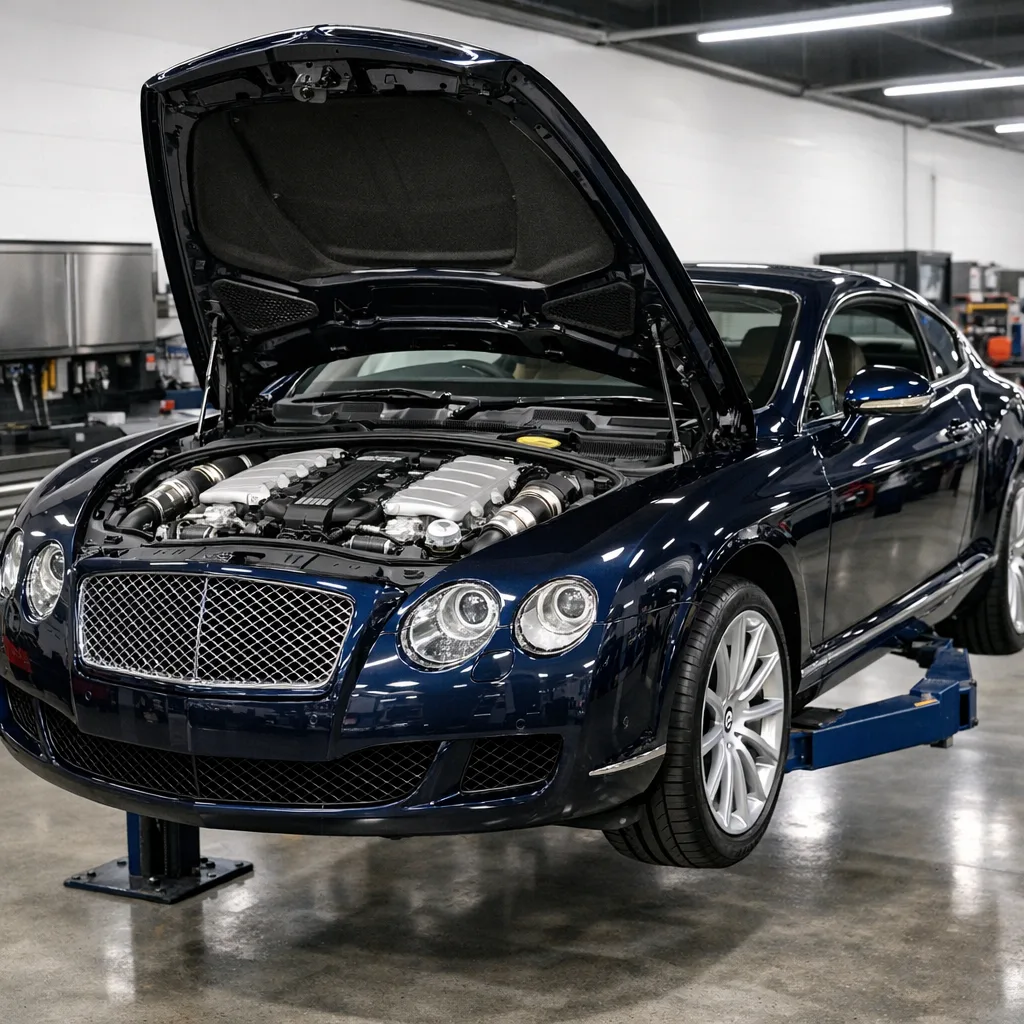
Get your Bentley booked in with a proper specialist.
What a Proper Service Schedule Looks Like
The W12 requires a full synthetic oil that meets the VW Group long life specification. Using anything below that in an engine with this many moving parts and this level of turbo loading is a false economy that shows up in wear metal readings and sludge over time. We use the correct grade and change the filter at the same time, every time.
A thorough service on this engine covers the full set of spark plugs, coil packs checked and replaced where needed, all drive belts inspected for cracking and correct tension, and the engine air filter replaced rather than blown out and refitted. The cabin filter on these cars sits in a location that most general workshops skip entirely, and it matters for both air quality and evaporator health. Fuel filter service and wiper blade replacement complete the picture.
A car that weighs over two tonnes and produces 625 hp needs brakes to match. The front and rear rotors on the Continental GT and Flying Spur are large, and pad material transfers to the rotor surface unevenly if the car sits for extended periods, which is common with vehicles used as weekend or occasional drivers. We measure rotor thickness and check for heat cracking, not just pad depth. We fit genuine, brand new OEM and OEM grade parts as standard on every job. These cars are expensive to own and expensive to repair when things go wrong, so there is no logic in fitting anything less than the correct specification part.
Our brake servicing covers the full pad and rotor service front and rear, and if you are curious about what goes into thorough brake work for a car at this performance level, we can walk you through it when you book.
How We Actually Diagnose These Cars
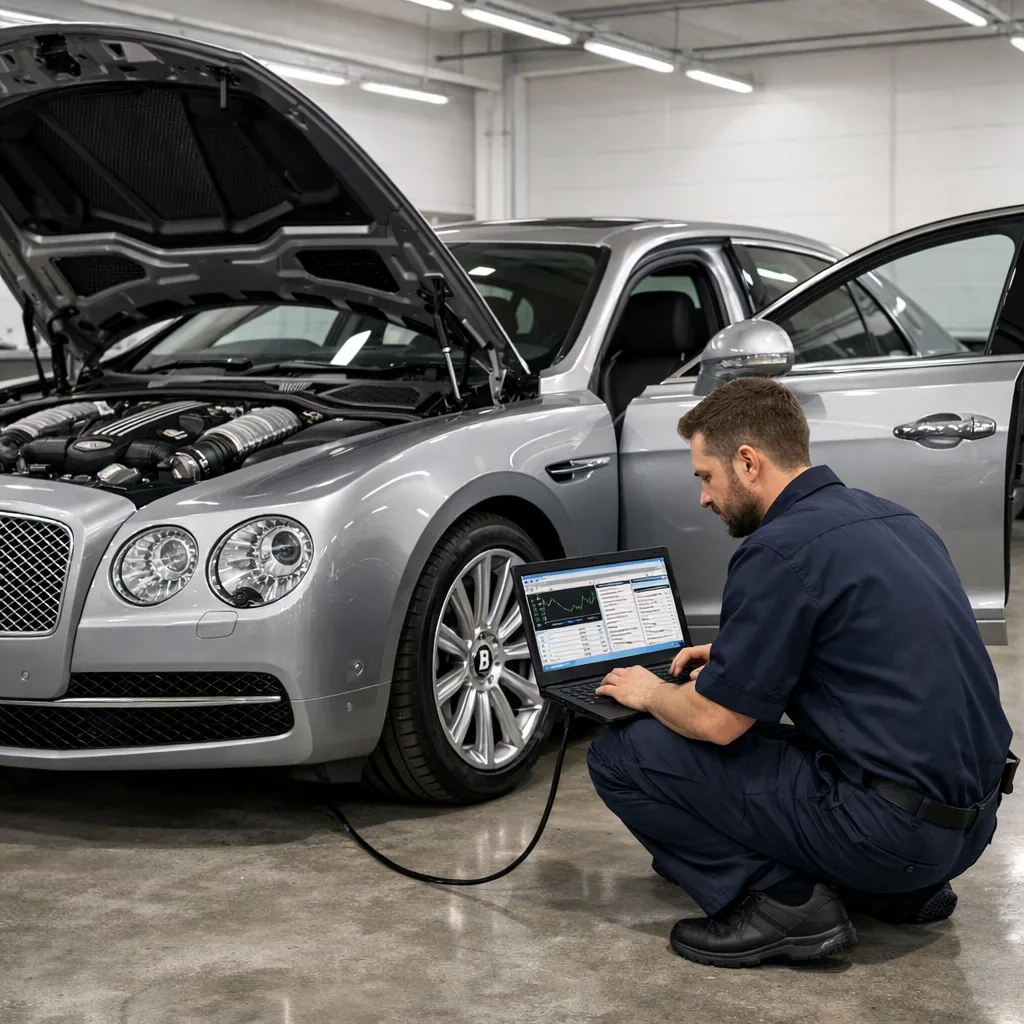
The VW Group ODIS platform is the factory diagnostic environment for these vehicles, and it is what we use. Generic scan tools read generic faults on these cars, which is a bit like reading the index of a book and thinking you have read the book. ODIS gives us full access to every control module across the car, including the engine management, the air suspension control unit, the transmission, and all the comfort and body systems.
We can perform guided fault finding, run component activation tests to isolate failures, and carry out the correct adaptations and coding after a repair so the system accepts the new part properly. That last point matters enormously on a car this complex. Fitting a new compressor or coil pack and not running the correct adaptation will simply produce a different fault code.
Live data from the Bosch ME17.1.6 ECU shows us exactly what the turbos are doing under load, where individual cylinder contributions sit, and whether the fuel trims are being pulled in directions that point to a boost leak or a fuelling issue. That kind of visibility is what separates a correct diagnosis from a parts lottery. Our workshop is at Unit 26, 930 Great South Road, Penrose, Auckland 1061. If you want to understand what your Bentley actually needs right now, an honest conversation and a proper diagnostic session with ODIS is the place to start.
Stage 1 Tuning: What the ECU Has Been Holding Back
All three W12 variants respond well to ECU tuning because Bentley calibrates the factory maps conservatively to accommodate fuel quality variation, emissions compliance, and warranty requirements. The hardware is capable of significantly more. All tuning work is delivered via the Bosch ME17.1.6 or ME7.1.1 platform as appropriate to the engine code, with the map written to the ECU directly through the OBD port. Because we are adjusting fuelling, boost targets, and ignition timing together rather than just turning up boost pressure, the result is a linear, driveable improvement across the rev range, not a spike at peak power that makes the car uncomfortable in everyday use.
Our Stage 1 tune for the BWR engine takes it from 560 hp and 650 Nm to 680 hp and 900 Nm, a gain of 120 hp and 250 Nm without any hardware changes. ECU platforms supported: Bosch ME17.1.6 and Bosch ME7.1.1.
The 575 hp CVAB unit moves to the same 680 hp and 900 Nm target, adding 105 hp and 200 Nm. ECU platforms supported: Bosch ME17.1.6 and Bosch ME7.1.1.
Even the already strong 625 hp CVA engine in the GT S gains a further 55 hp and 100 Nm to reach 680 hp and 900 Nm from the factory ECU alone. ECU platform: Bosch ME17.1.6.
Additional tuning options available for all three engine variants include a pop and bang crackle map for a more characterful overrun note, start/stop system disable, and Vmax limiter removal for track use. DECAT and exhaust flap tuning options are also available. Any removal of emissions components is for off road or track use and may affect WOF compliance, so we discuss the implications with every owner before any work is carried out. If you want to explore the full range of tuning options for the W12, bring the car in and we can review what suits your use. You can also review the genuine power gains available on the W12 before you book.
Off-road and motorsport use only. EGR, DPF, AdBlue, decat and related DTC options are not road legal in New Zealand, and a vehicle with them will not pass a WOF.
Frequently Asked Questions
The questions we get most. Something else on your mind? Get in touch.