Jaguar X Type: Every Generation Explained, Serviced and Fixed
The X Type was Jaguar's boldest experiment: take the Ford Mondeo platform, dress it in proper Jaguar bodywork and leather, offer it with all wheel drive and a choice of V6 or diesel engines, and see if buyers would buy into the badge at a friendlier price. Plenty of New Zealand buyers did, and now those cars are ageing into the used market with a set of predictable faults that reward owners who stay on top of them and bite those who don't. Four variants arrived here worth knowing: the 231hp 3.0 V6, the 194hp 2.5 V6, the 155hp 2.2D, and the 130hp 2.0D. Same bones, different personalities, different weak spots.




X Type 3.0 V6: The Range Topper With a Plastic Achilles Heel
The 3.0 V6 is the flagship of the X Type petrol range. The AJ30 engine displaces 2968cc, runs a 10.5:1 compression ratio with an 89.0 x 79.5mm bore and stroke, and puts out 231hp and 284Nm through a Denso MB079700 ECU. All wheel drive came as standard on this engine, which is a big part of its appeal on New Zealand roads. It's the most powerful and the most expensive to sort when things go wrong, but get it well maintained and it's a genuinely satisfying drive.
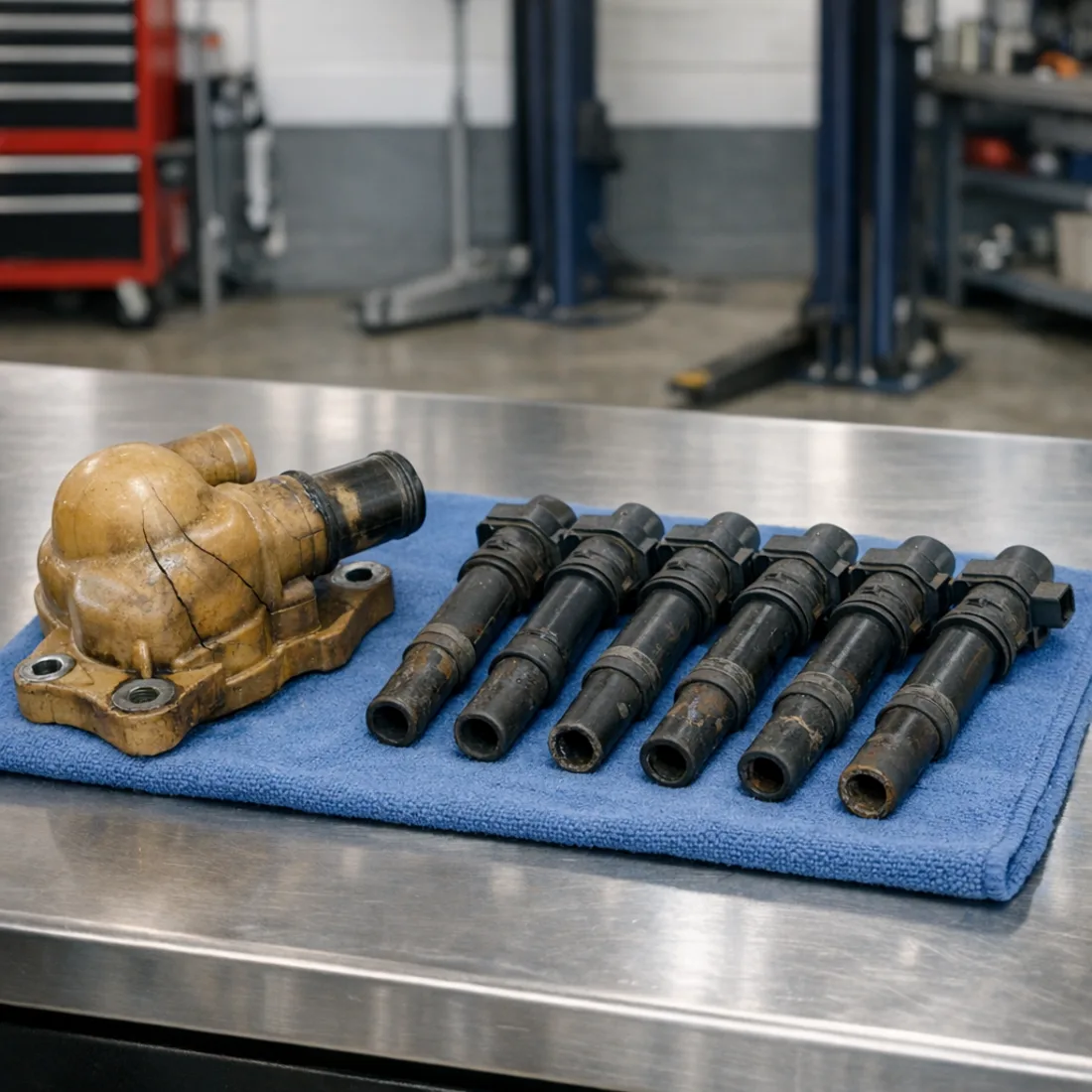
The fault that gets the most of these through our door? The plastic thermostat housing. It was a cost saving measure Jaguar clearly regretted, because when it cracks or weeps, coolant disappears quietly and the engine can overheat before the driver realises there's a problem. Coolant leaks from this housing and from the water pump are so common on the 3.0 that it's worth inspecting both proactively rather than waiting for the temperature gauge to misbehave.
-
Plastic thermostat housing cracking and coolant leaks
-
Coil pack failures causing misfires, often on multiple cylinders
-
Variable valve timing noise with neglected oil changes
-
Transfer case and rear differential wear on higher mileage AWD cars
-
Water ingress into the boot
-
Electrical gremlins across various modules
The plastic thermostat housing was a cost saving measure Jaguar clearly regretted.
When it cracks or weeps, coolant disappears quietly and the engine can overheat before the driver realises there's a problem.
The six coil packs are another known point of failure. When one goes, rough running and a misfire code appear, but worn coils can also cause intermittent misfires that a generic scanner won't pin down accurately. We diagnose these with Jaguar's factory level SDD and Pathfinder platforms, which is the only way to read live module data and reset service items correctly on these cars. A generic OBD reader will get you a fault code, but it won't tell you the full story.
The AWD system also needs attention at higher mileage. The transfer case and rear differential aren't especially fragile, but they don't like being ignored either. Clunking, vibration, or binding on tight turns can all point here. Suspension bushes and arms soften with age too, and a car that hasn't had those refreshed will feel quite vague compared to what it should be. Stage 1 tuning on the AJ30 takes output to 245hp and 305Nm, a gain of 14hp and 21Nm. It's a modest but real improvement in throttle response and mid range pull, and it suits the character of the engine well.
Get your X Type booked in with a proper specialist.
X Type 2.5 V6: The Smart Buy in the Petrol Range
The 2.5 V6 shares the same X400 platform and the same Denso MB079700 ECU as the 3.0, and in many ways it's the more sensible petrol choice for daily use. At 194hp and 244Nm from 2495cc, with a 10.3:1 compression ratio and an 81.6 x 79.5mm bore and stroke, it's not lacking for real world performance. Running costs are a touch lower than the 3.0, and it came with AWD as standard too.
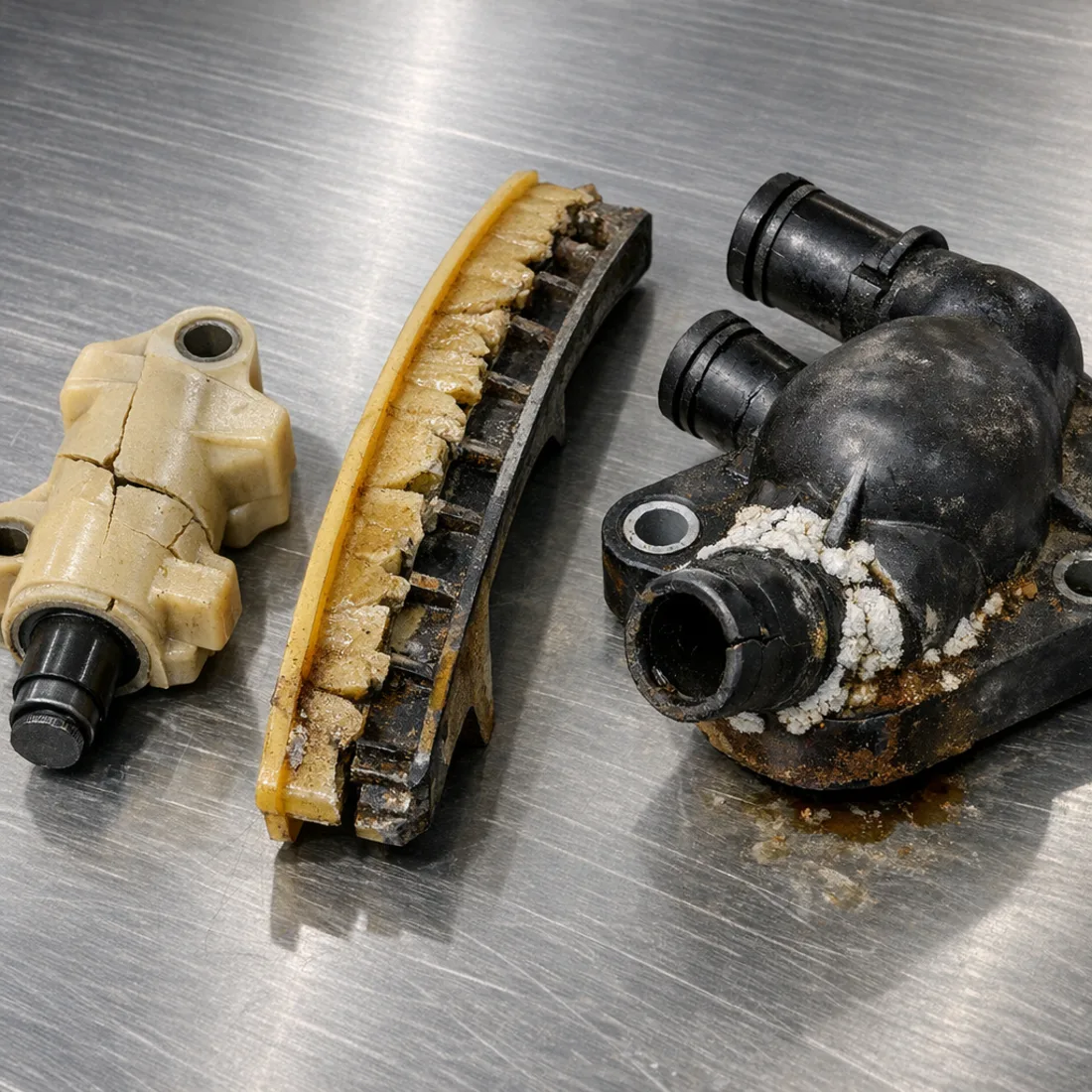
What's interesting when you compare the two petrol V6s is that the 2.5 shares most of the 3.0's weak spots but adds a couple of its own. The plastic thermostat housing and cooling system leaks are just as present here. Coil pack and ignition faults appear in the same way. But the 2.5 also shows more frequent complaints about the timing components and tensioners than the 3.0 does in our experience. Worn timing tensioners are worth inspecting on any high mileage example, because if a tensioner lets go, the repair bill climbs quickly.
-
Plastic thermostat housing leaks and water pump failures
-
Timing chain tensioner wear on higher mileage engines
-
Oil leaks from front and rear crankshaft seals
-
Coil pack faults and rough running
-
Throttle body issues affecting driveability
-
AWD prop shaft and CV joint wear
-
Front subframe bush softening with age
The 2.5 Stage 1 tune reaches 210hp and 264Nm, bringing it meaningfully closer to stock 3.0 territory.
For most daily use, the 2.5 is the sweet spot in the petrol range.
The throttle body on the 2.5 can also cause driveability complaints, particularly hesitation and uneven idle, that owners sometimes mistake for an ignition fault. Getting the right factory diagnostic data is the only way to separate these cleanly, which is exactly why we run SDD and Pathfinder rather than a generic reader on these cars.
If you're comparing the 2.5 to the 3.0 on a used buy, the 2.5 is often priced lower but the fundamentals are very similar. The 3.0 gives you more performance headroom and a slightly better Stage 1 result in terms of absolute numbers, but the 2.5 Stage 1 tune reaches 210hp and 264Nm, a gain of 16hp and 20Nm, which brings it meaningfully closer to stock 3.0 territory. For most daily use, the 2.5 is the sweet spot in the petrol range.
X Type 2.2D: The Torque Monster That Hates Short Trips
Switch to the diesels and the character of the X Type changes completely. The 2.2D uses Ford's DURATQ22 DuraTorq unit: 2198cc, an 86.0 x 94.6mm bore and stroke, a 17.5:1 compression ratio, and a Delphi MPC555 ECU managing it all. Factory output is 155hp and a very healthy 360Nm of torque, which makes it feel quicker in real world driving than the numbers suggest. When it's running well, it's a genuinely relaxed and capable car.
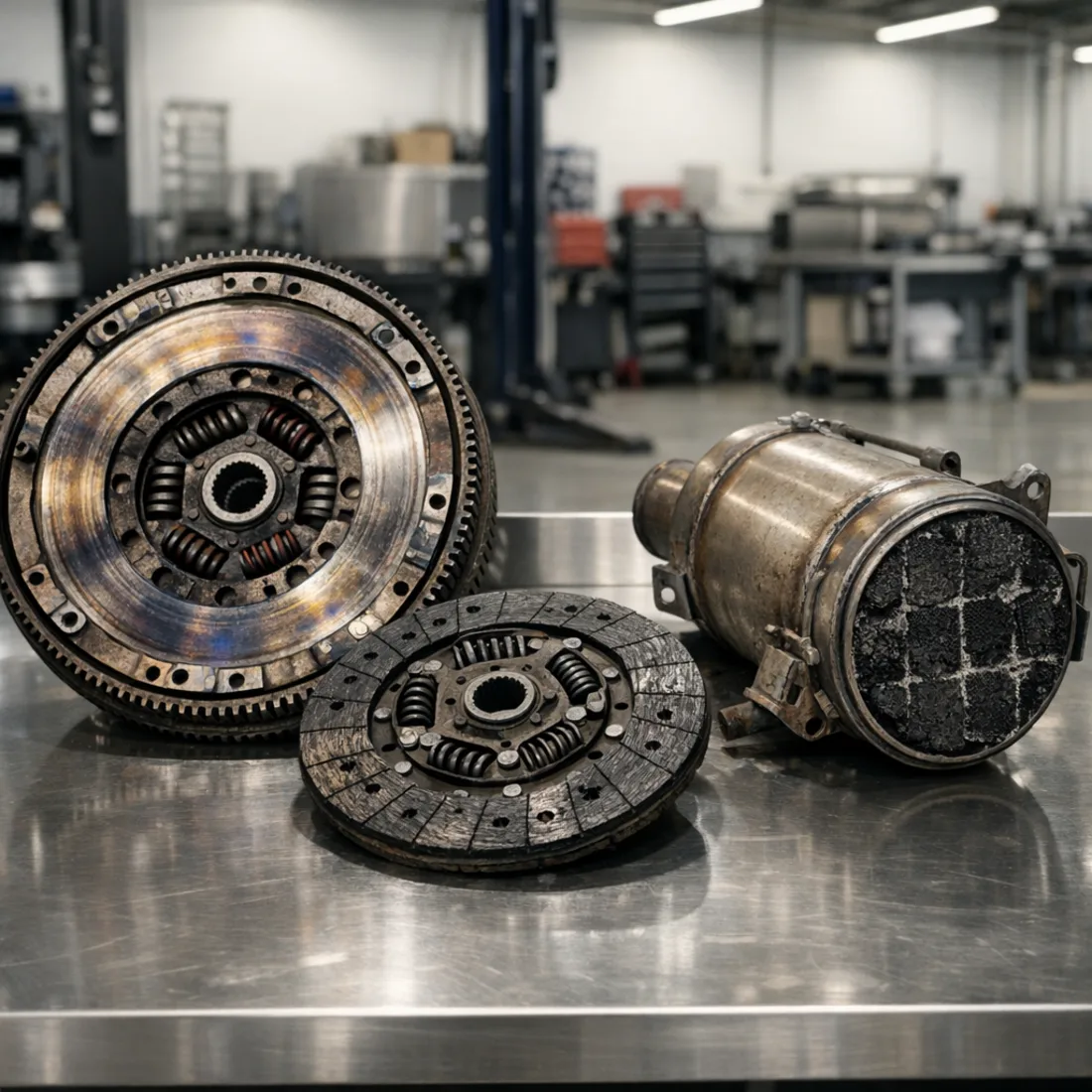
The 2.2D has a different set of problems to the petrol V6s, and the most physical one is the dual mass flywheel. Rattle at idle and shudder when pulling away from a standstill are the classic signs of a flywheel on its way out. It's not a cheap fix, but there's no ignoring it either, and if the clutch needs doing at the same time, it makes sense to address both together rather than pay labour twice.
-
Dual mass flywheel wear causing rattle at idle and clutch judder
-
DPF clogging on cars used mainly for short trips around the city
-
EGR valve carbon buildup causing rough running and limp mode
-
Swirl flap failures in the intake manifold
-
Turbo actuator and boost issues on higher mileage examples
-
Timing belt replacement as a scheduled maintenance item
Auckland driving is exactly the wrong environment for a diesel particulate filter to regenerate properly.
Cars that have spent most of their lives in town can arrive with a DPF that's heavily loaded.
The DPF is worth a specific mention. Auckland driving, with its stop start traffic and short commutes, is exactly the wrong environment for a diesel particulate filter to regenerate properly. Cars that have spent most of their lives in town can arrive with a DPF that's heavily loaded. We assess DPF health as part of diagnosis and carry out cleaning or replacement where needed, using genuine components. The EGR valve carbon buildup is a separate but related problem: heavy carbon deposits restrict airflow, the engine runs poorly, and eventually limp mode kicks in. Cleaning the EGR and the intake tract restores proper operation where the hardware is still sound.
The Stage 1 tune on the 2.2D is genuinely impressive: 185hp and 440Nm, a gain of 30hp and 80Nm. That 80Nm torque gain transforms the character of the car in everyday driving. It's the largest gain of any X Type variant we tune, and on a car that's already healthy, it's very worthwhile.
X Type 2.0D: The Frugal Entry That Punches Above Its Weight Tuned
The 2.0D is the most accessible X Type in terms of purchase price and running costs, and it's the one that gets overlooked most often. The engine is Ford's DuraTorq common rail diesel, coded X404: 1998cc, a perfectly square 86.0 x 86.0mm bore and stroke, an 18.2:1 compression ratio, and the same Delphi MPC555 ECU as the 2.2D. Factory figures are 130hp and 330Nm. It's not fast, but on the open road it's relaxed and economical, and in town it makes good use of that torque.
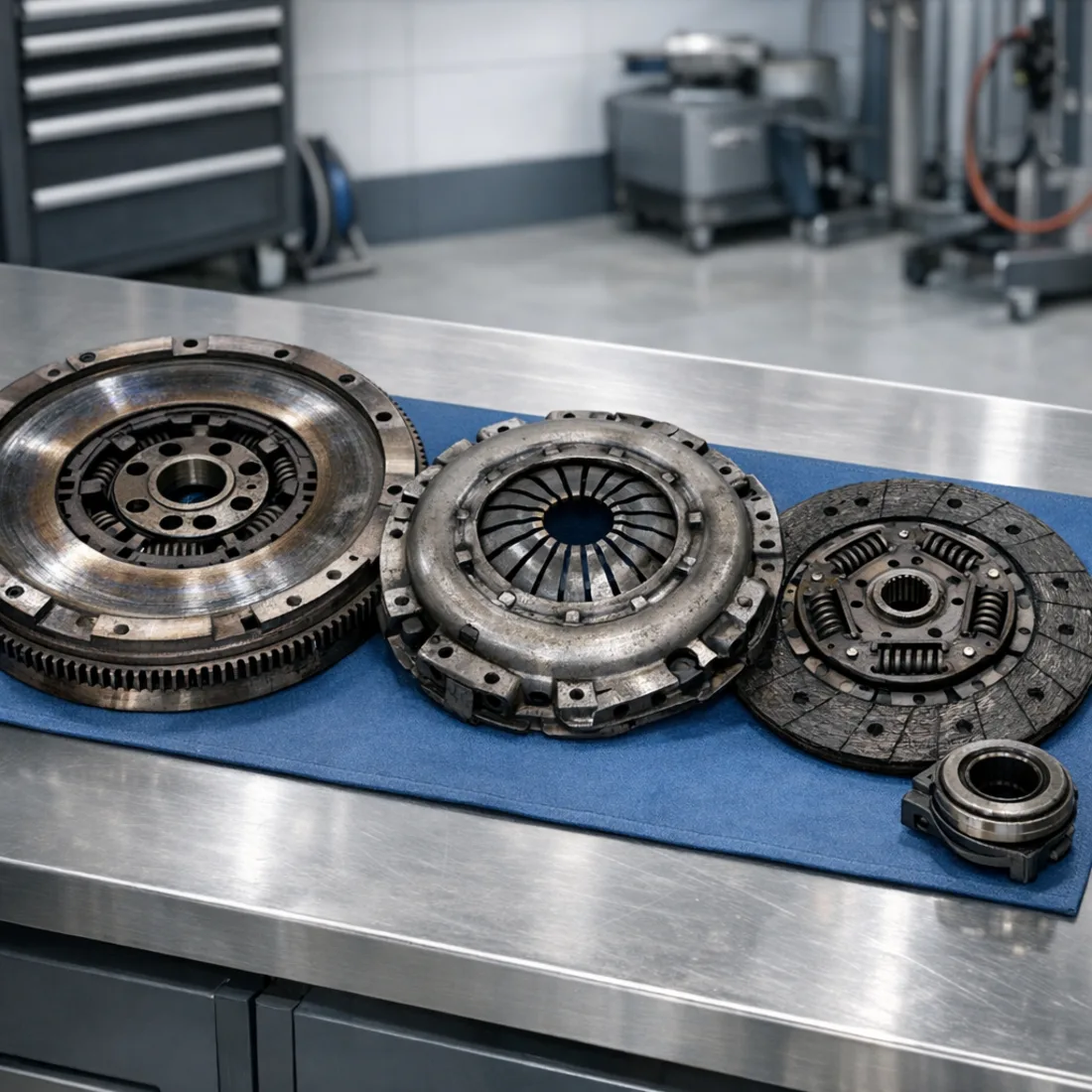
The 2.0D shares most of the 2.2D's known faults, which isn't surprising given the shared engine family. The dual mass flywheel and clutch are the most common mechanical complaint: shudder on take off and a rattling idle are the giveaways. Turbo actuator and boost problems appear on higher mileage cars, and EGR clogging is a routine service issue. Swirl flaps are worth checking at diagnosis, and DPF health should be assessed on any car that's been used predominantly for short trips.
-
Dual mass flywheel and clutch wear causing shudder and rattle
-
Turbo actuator faults and boost irregularities
-
EGR valve clogging and inlet manifold carbon buildup
-
Swirl flap condition worth checking at each service
-
DPF loading on short trip city cars
-
Timing belt renewal as a critical scheduled job
A Stage 1 tune takes the 2.0D to 166hp and 380Nm: the largest percentage gain of the four X Type variants.
Suddenly a car that felt a little underpowered on the motorway has real overtaking ability and noticeably better response.
Where the 2.0D really surprises people is with tuning. A Stage 1 tune takes it to 166hp and 380Nm, a gain of 36hp and 50Nm. That's the largest percentage gain of the four X Type variants. Suddenly a car that felt a little underpowered on the motorway has real overtaking ability and noticeably better response. On a car that's been properly serviced and is mechanically sound, it's the single biggest improvement you can make.
Compared to the 2.2D, the 2.0D is a touch less torquey from the factory but responds even better to tuning on a relative basis. If you're buying used and daily driving is the priority, the 2.0D is worth serious consideration, especially at the price point these tend to sell for now.
Picking Between Them: A Buying Guide Across the Range
If you're shopping used, the decision really comes down to how you use the car and what you're willing to manage. Across all four, a full service history is worth more than it is on many other cars. These are vehicles where deferred maintenance shows up quickly and the faults can be expensive to catch up on. A well kept example of any variant is worth paying more for up front.
You want the most performance and presence and have a documented service history to lean on. Buy one that has had the thermostat housing and coil packs addressed. Check the AWD system for noise and binding before purchase. Be prepared for the highest running costs of the four.
You want the sweet spot in the petrol range. Similar platform to the 3.0 but slightly lower costs, and the Stage 1 tune closes much of the performance gap. Inspect the timing tensioners on anything above moderate mileage.
You want effortless torque and are comfortable managing diesel servicing properly. Don't buy one used without checking the DPF and flywheel condition. It rewards high mileage motorway use far more than short urban trips.
Accessibility and tuning value are priorities. The most accessible entry point and the one with the most to gain from tuning. Solid choice if the price is right and the service history is there. Same diesel maintenance caveats apply as the 2.2D.
- Check full service history on any variant before purchase
- Inspect the plastic thermostat housing and coolant level on both petrol V6s
- Test for coil pack misfires on the AJ30 and X400
- Check timing tensioner condition on high mileage 2.5 V6 examples
- Check AWD for clunking, vibration or binding on petrol models
- Assess DPF health on both diesel variants, especially city use cars
- Check dual mass flywheel for rattle at idle and clutch shudder on diesels
- Confirm timing belt history on both 2.2D and 2.0D
- Check EGR and swirl flap condition on diesel variants
Servicing Across the Entire X Type Family
The service schedules differ between the petrols and the diesels, but both need proper attention to the correct specifications. Using the wrong oil grade on either engine type causes accelerated wear and can mask emerging problems with oil pressure behaviour. We use the correct grade for each variant every time, with brand new genuine and OEM parts throughout.
For both petrol V6s, the routine service list covers: oil and filter to the correct grade for the AJ30 or X400 engine; air filter, cabin filter, fuel filter; spark plugs and all six coil packs where due; drive belts and tensioners; coolant and thermostat housing inspection and renewal; brake pads and rotors, sensors; suspension bushes, arms and joints.
For the diesel variants, the list shifts to reflect their different needs: oil and filter to the correct low SAPS diesel specification; air filter, fuel filter, cabin filter; glow plugs, drive belts, wipers; timing belt renewal at the scheduled interval (critical on both diesel engines); clutch and dual mass flywheel inspection and replacement where needed; DPF health assessment and cleaning or replacement as required; EGR valve and intake manifold cleaning; brake pads and rotors; suspension refresh. For clutch replacements, brake work or suspension repairs, our mechanical repairs team handles those in the same workshop visit where possible.
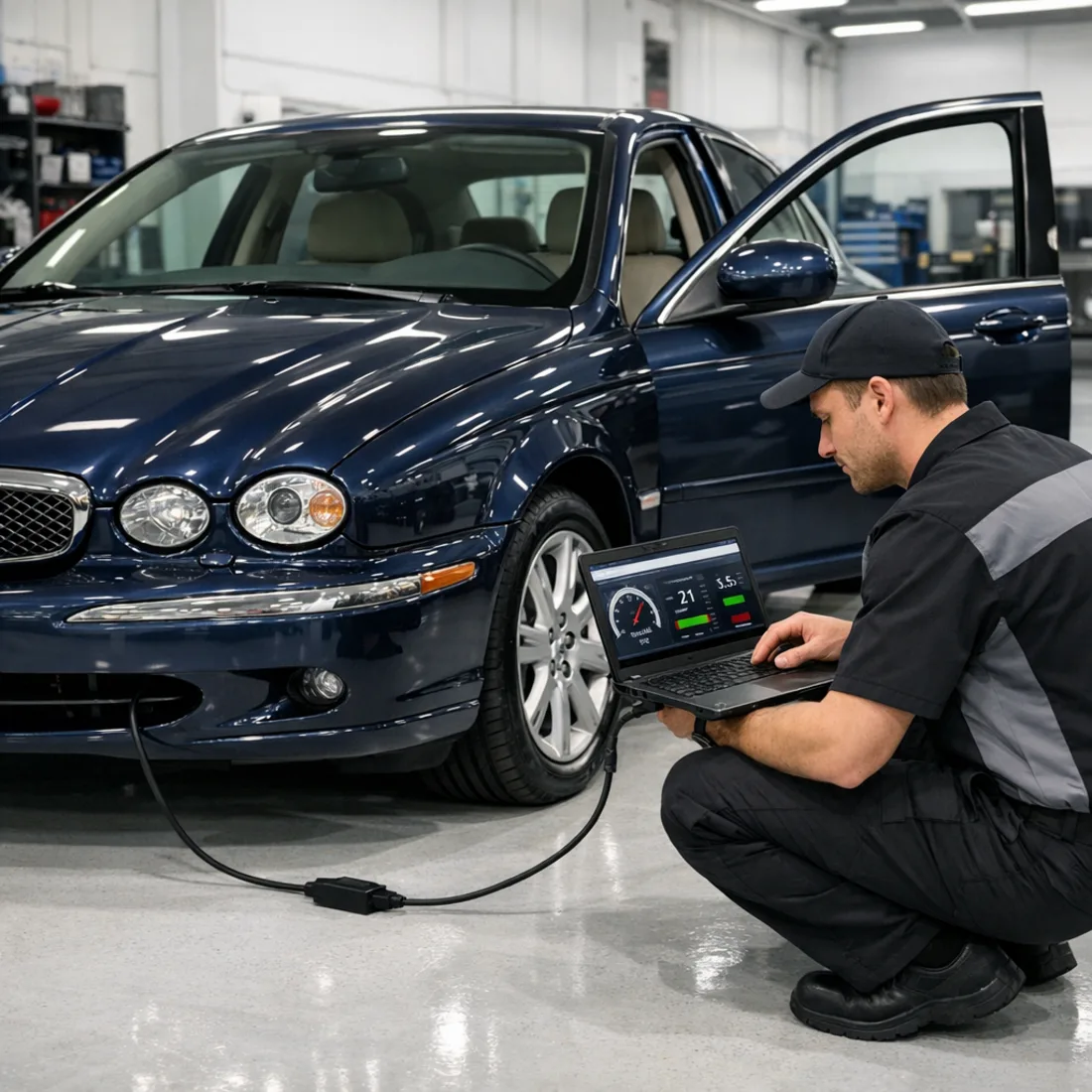
How We Diagnose X Types: Factory Tools, Not Guesswork
Every X Type variant, petrol or diesel, needs factory level diagnostic software to be read properly. We use Jaguar's SDD and Pathfinder platforms with a proper interface, not a generic OBD reader from a parts shop. The difference matters on these cars. A generic reader will pull a fault code, but it won't give you live module data, it won't let you run actuator tests, and it won't reset service items or configure replacement parts correctly.
On the petrol V6s, proper diagnostics lets us separate a genuine coil pack fault from a throttle body or VVT issue that throws similar symptoms. On the diesels, it lets us read boost, EGR flow, DPF soot loading and glow plug health from the actual ECU data rather than guessing from symptom descriptions alone.
The Delphi MPC555 ECU in both diesel variants and the Denso MB079700 in both petrols have known quirks in how they report faults. Getting accurate data out of them requires the right tool talking the right protocol, which is exactly what SDD and Pathfinder provide. If you've had fault codes cleared elsewhere without the underlying cause being fixed, we'll find it. For key and immobiliser issues across the range, we also handle immobiliser and key programming with the correct factory tooling, so a lost key or a failed immobiliser doesn't mean an expensive dealer visit.
Tuning the X Type Range: Real Gains, Sensible Expectations
All four X Type variants respond to Stage 1 tuning, and the gains vary considerably across the range. The diesels gain the most, both in absolute numbers and as a percentage. The 2.2D's 80Nm torque gain is transformative in daily driving. The 2.0D's 36hp gain is the largest proportional power increase of the four. On the petrols, the gains are real and noticeable in throttle response and mid range pull, even if the absolute numbers are more modest. One important caveat: we won't tune a car that isn't mechanically sound. If the engine has a running fault, a leaking cooling system, or worn ignition components, those get fixed first. A tune applied to an unhealthy engine doesn't produce the numbers and can mask underlying problems. Get the car right, then tune it.
A modest but real improvement in throttle response and mid range pull. The AJ30 responds well to a remap, and the gain suits the character of the engine well. DTC Removal, DECAT, FLAPS and Vmax work also available.
Brings the 2.5 meaningfully closer to stock 3.0 territory, which changes the value equation significantly for daily drivers. DTC Removal, DECAT, FLAPS and Vmax work also available.
The largest absolute torque gain of the four. That 80Nm transforms the character of the car in everyday driving. On a car that's already healthy, it's very worthwhile. FLAPS, Vmax and Adblue work also available.
The largest percentage gain of all four variants. Suddenly a car that felt underpowered on the motorway has real overtaking ability and noticeably better response. The single biggest improvement you can make to a healthy 2.0D. FLAPS, Vmax and Adblue work also available.
All tuning work is carried out after a mechanical assessment. If there are running faults, cooling system issues, or worn ignition or injection components, those are addressed first. A healthy engine handles the increased outputs without issue. Read more about our approach on the ECU file service page.
Frequently Asked Questions
The questions we get most. Something else on your mind? Get in touch.