Freelander 2 TD4 Service, Repairs and Diagnostics
Picture a Friday afternoon in West Auckland, rain coming sideways, a family of four piled in with a boot full of camping gear. The Freelander 2 handles it without a second thought. Capable, compact and genuinely useful, it became one of the more popular European SUVs to land in New Zealand driveways during the late 2000s and early 2010s. Plenty of them are still out there, clocking up motorway kilometres and the occasional gravel road. The catch? A Land Rover is not a set and forget machine, and the 2.2 TD4 in particular has a handful of well known pressure points that show up once the odometer climbs past the 100,000 km mark.

The 224DT Engine: What You Are Actually Driving
The Freelander 2 TD4 runs the 2.2 litre four cylinder diesel known internally as the 224DT. Capacity is 2179 cc, bore and stroke sit at 85.0 mm by 96.0 mm, and the compression ratio is 15.8:1. In standard tune Land Rover rated it at 190 hp and 420 Nm of torque, which gives it a relaxed, pulling character well suited to loaded motorway runs and light off road work. The brain of the engine is a Bosch EDC17CP42 engine control unit, a capable piece of hardware that manages fuel delivery, turbo boost, emissions systems and a lot more besides.
It is a fundamentally solid engine when it is looked after. The trouble is that the emissions architecture around it, the DPF, the EGR, the swirl flaps, the breather system, all of it demands regular attention and the right kind of driving. City commuters and short trip school run vehicles tend to suffer more than highway cars, and that is true across the whole range of common faults below.
-
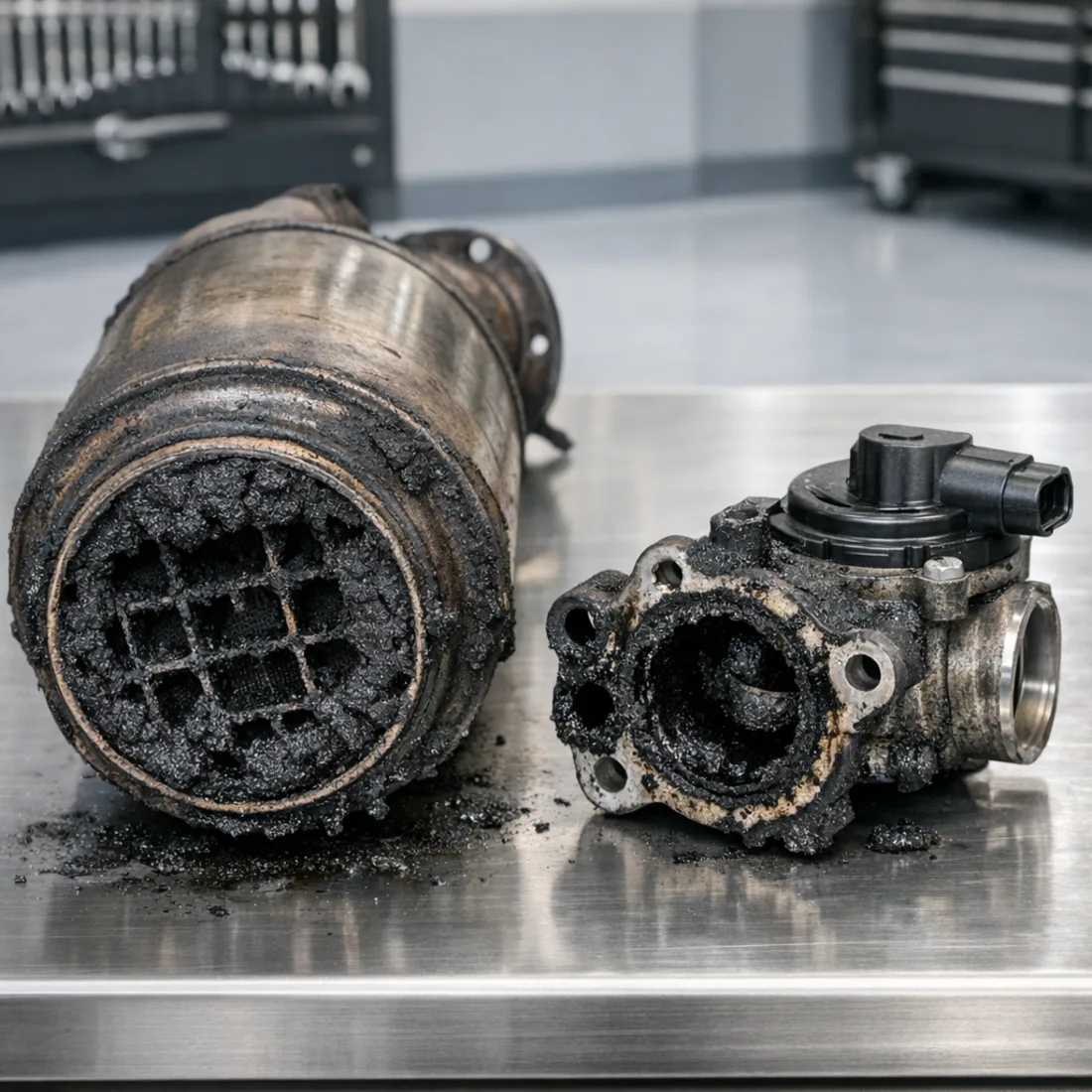
DPF and EGR Clogging: Short, low speed trips mean the DPF regen never finishes, the filter fills up, and eventually an amber DPF warning light appears followed by limp mode. Left long enough, the filter bakes solid and needs replacement rather than cleaning. The EGR valve accumulates carbon in the valve body and intake manifold, causing rough idle, hesitation on acceleration and boost faults logged in the ECU.
-
Swirl Flaps and Intake Carbon: The 224DT uses swirl flaps in the intake manifold to improve combustion efficiency at low loads. Carbon build up causes them to stick or snap, and a broken flap blade can be ingested by the engine. The symptom is usually a rough idle, an EML light and a fault relating to intake air flow.
-
Turbo Actuator Faults and Injector Wear: Soot build up on the variable geometry turbo vanes causes sticking and a boost control fault. The result is either no boost or uncontrolled over boost, both sending the car into limp mode. Worn injectors contribute to rough running, excessive smoke and difficult cold starts on high mileage examples.
-
Haldex All Wheel Drive Coupling: The Haldex coupling has its own oil and filter that most owners and even some workshops forget entirely. Neglected fluid becomes contaminated, the filter blocks, and the coupling runs dry. The first sign is often a handling oddity or a clunk on tight corners. Left alone it fails completely, which is an expensive rear drive unit replacement.
-
Suspension Bushes and Rear Wheel Bearings: Auckland roads are not kind to rubber. The Freelander 2 rear suspension bushes wear and allow vague, floaty handling and a knock over sharp bumps. Rear wheel bearings are another age and mileage item; the early warning is a low frequency hum from the rear that changes pitch as you change speed.
We do not replace parts to see if the light goes out.
For the 224DT we pull live injector balance rates, boost pressure versus target, EGR position feedback and DPF soot load values during a diagnostic session.
Generic scan tools read generic faults. They are useful for a starting point, but on a Land Rover they miss module specific data, live parameter streams and the coding functions you need after a repair. We use the factory Land Rover diagnostic platform, SDD (Symptom Driven Diagnostics) and Pathfinder, the same software the dealer network uses. That means we can read every module on the vehicle, view live data from the EDC17CP42 fuel system, check Haldex coupling status, interrogate the ABS and traction control modules, and perform the post repair coding and resets that the car expects before it will operate normally.
The 224DT needs a low SAPS diesel engine oil, a full synthetic that meets the Land Rover specification. Standard mineral or semi synthetic oils accelerate DPF clogging because they leave higher ash deposits during combustion. Using the correct oil grade is one of the simplest and most effective ways to extend DPF life. Our scheduled car servicing covers the full range of fluid and filter work: oil and filter, air filter, fuel filter, cabin pollen filter, wiper blades and drive belts at the appropriate intervals. Other wear items we service on these vehicles include the timing chain assembly, the clutch on manual versions, DPF cleaning or replacement, EGR cleaning or replacement, and the Haldex coupling oil and filter service. If your Freelander 2 has AdBlue, we handle that system too, covering correct fluid top up, sensor faults and NOx system diagnostics. Everything we fit is brand new, genuine OEM or OEM grade quality. We do not use second hand or reconditioned parts. You get the correct component, fitted correctly, with the proper post installation calibration where the vehicle requires it.
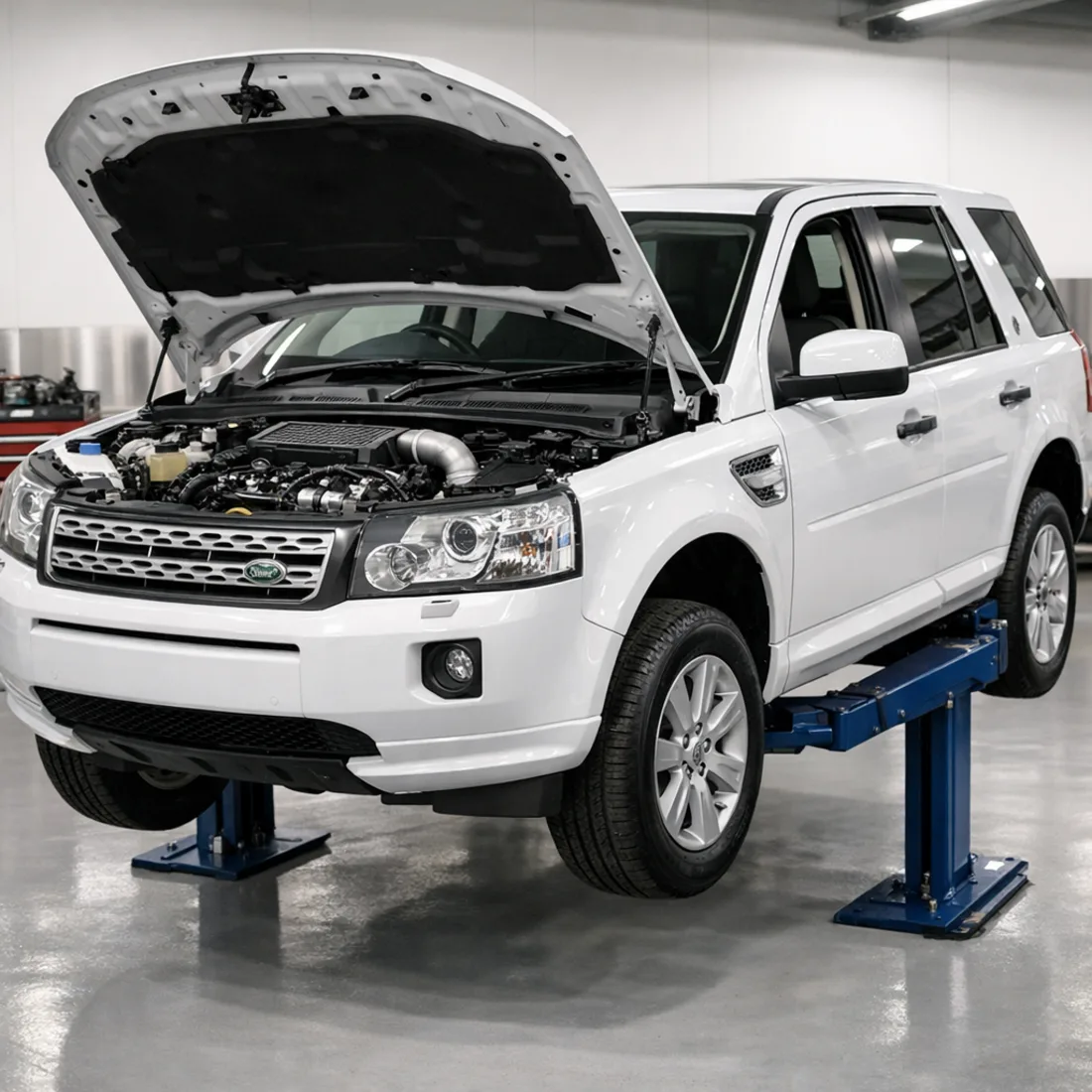
Get your Freelander 2 booked in with a proper specialist.
Glow Plugs, Brakes and Every Wear Item Covered
Glow plugs on the 224DT take the strain of every cold start. Failing plugs show up as hard morning starts, white smoke on startup and, on the SDD system, individual glow plug circuit faults. Replacement as a set at the right mileage interval is far cheaper than a cold start no start in the middle of winter.
Brake pad and rotor replacement on the Freelander 2 is a regular item; the vehicle is heavy relative to its footprint, and the brakes work hard. Our team handles pad and rotor replacement with new OEM grade components, including the electronic parking brake reset procedure the rear calipers require on later models. We also cover suspension bush replacement front and rear, rear wheel bearing replacement, and the Haldex all wheel drive coupling oil and filter service.
How We Actually Diagnose These, Not Just Guess
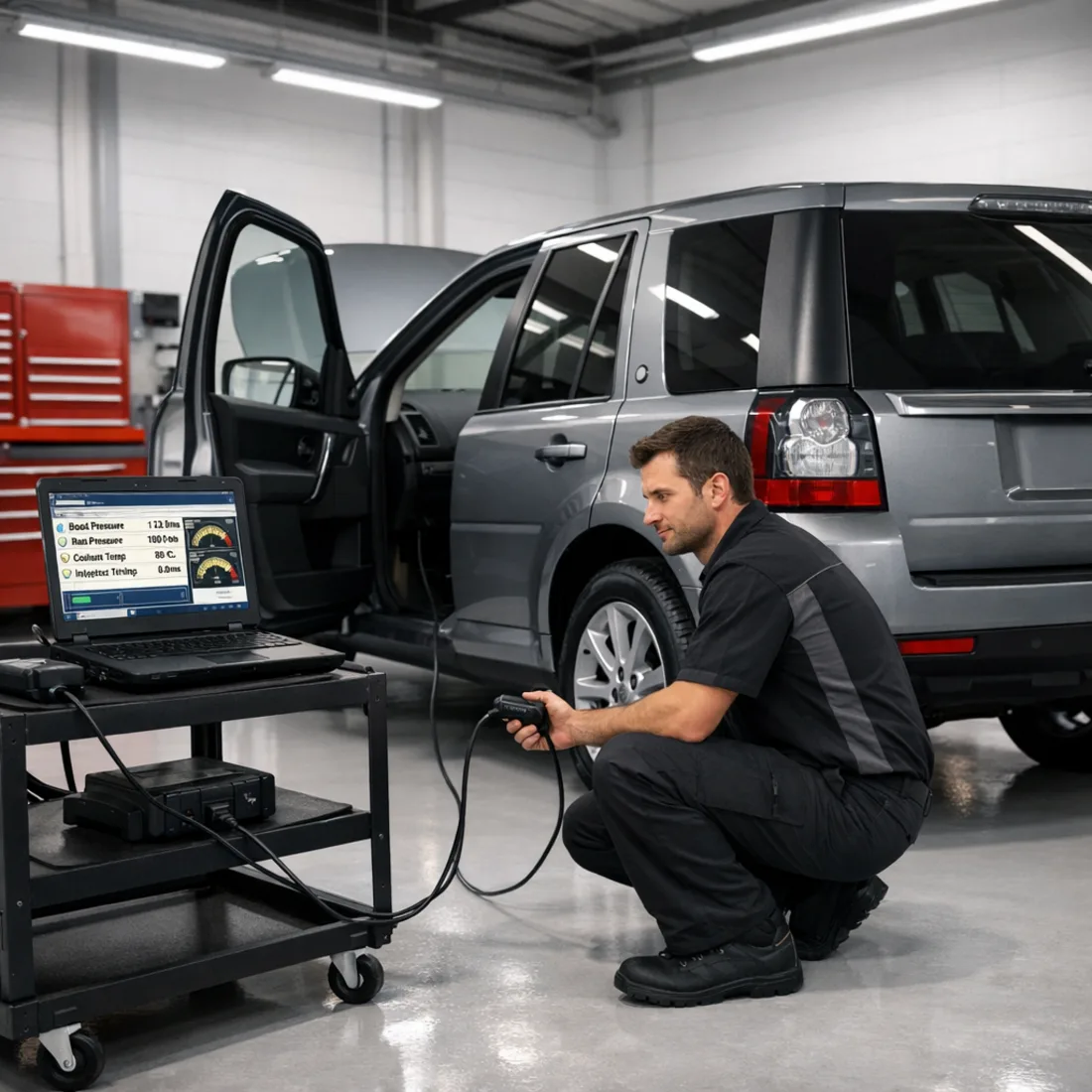
Generic scan tools read generic faults. On a Land Rover they miss module specific data, live parameter streams and the coding functions you need after a repair. We use the factory Land Rover diagnostic platform, SDD and Pathfinder, the same software the dealer network uses. That means we can read every module on the vehicle, view live data from the EDC17CP42 fuel system, check Haldex coupling status, interrogate the ABS and traction control modules, and perform the post repair coding and resets that the car expects before it will operate normally. It is the difference between reading a fault code and actually understanding why it is there.
For the 224DT specifically, we pull live injector balance rates, boost pressure versus target, EGR position feedback and DPF soot load values during a diagnostic session. That data tells us whether you need a clean, a calibration, a replacement part or just a long motorway run to finish a stuck regen. We do not replace parts to see if the light goes out.
Stage 1 Tuning for the 224DT
The Bosch EDC17CP42 ECU responds well to a proper calibration. Our Stage 1 tune takes the 224DT from the factory 190 hp and 420 Nm to 215 hp and 470 Nm, a gain of 25 hp and 50 Nm of torque, without touching a single mechanical component. The result is a noticeably more relaxed motorway cruiser with better overtaking response and, often, marginally improved fuel efficiency because you are working the engine less hard to maintain speed.
We write the tune through the ECU directly using our file service platform. Additional options available for this engine include start stop deactivation, speed limiter adjustment, intake flap management and pop and bang crackle mapping for those who want something a little more characterful.
If you want to explore the full range of calibration options beyond a simple power tune, our ECU file service covers the complete list of maps available for the 224DT platform.
Frequently Asked Questions
The questions we get most. Something else on your mind? Get in touch.