Toyota Corolla 2.0 D-4D: Servicing, Repairs and Tuning in Penrose, Auckland
The Toyota Corolla has always been the sensible choice. Reliable, practical, easy to live with. But the E15 generation's 2.0 D-4D variant is a different beast to the petrol models most people picture when they hear "Corolla". Under the bonnet sits Toyota's 1AD FTV, a 1998cc square bore diesel (86mm bore, 86mm stroke) with a compression ratio of 16.8:1, pushing out 126hp and a genuinely useful 300Nm of torque. It's a car that rewards careful ownership. It also shows no mercy when that ownership lapses. We've had plenty of these on the hoist, and the stories they tell are pretty consistent.
The 1AD FTV: What Makes It Tick, and What Can Go Wrong
The 1AD FTV is a modern common rail turbo diesel and on paper it should be bulletproof. In practice, it has a handful of well known weaknesses that appear in a predictable order as the kilometres stack up. Knowing what to watch for is half the battle.
This is the number one headache with this engine. The diesel particulate filter is doing exactly its job, trapping soot, but it needs a sustained run at highway speed to complete a passive regeneration and burn that soot off. A car that spends its life on school runs and suburban errands never gets warm enough for that to happen. The DPF slowly fills up until the warning light comes on, regeneration fails, and you're looking at either a professional clean or a replacement filter. We handle both: a genuine forced regeneration using Toyota Techstream to command the process properly, or a full clean if the filter is already restricted beyond what a regen can fix. If the filter itself is damaged, we replace it. For vehicles that will spend their life off road and never see a WOF, a DPF off solution is also available, though it's worth understanding that removes WOF compliance for road use.
The exhaust gas recirculation valve on the 1AD FTV is positioned to take a steady stream of hot, oily exhaust gases and meter them back into the intake. Over time, that builds up a thick carbon crust inside the valve and the intake tract. When it sticks open you get rough idle, poor throttle response and black smoke. When it sticks shut, you can get elevated NOx and the engine can run lean at light loads. We clean the EGR system and the intake properly, and where the valve itself is worn past cleaning, we replace it. We can also assess whether an EGR off calibration is appropriate for your use case, noting again that this carries compliance considerations for road registration.
This one is less forgiving. The AD series diesel engines are well documented for injector tip wear and, in more severe cases, piston damage when the oil service has been skipped or the wrong grade used. The 1AD FTV needs a low SAPS full synthetic diesel oil, specifically to protect the DPF and to keep injector lubrication right. Running a standard oil or going over the service interval degrades that protection fast. Symptoms start subtly: a small amount of white smoke on cold start, rough running, a slight miss. Left long enough, it becomes an injector replacement job or worse. We check injector operation as part of our diagnostic process and catch this early where possible.
-
DPF clogging on short run cars that never reach regeneration temperature
-
EGR valve carbon build up causing rough idle, poor throttle response and black smoke
-
Injector and piston wear from neglected oil service or incorrect oil grade
-
Swirl flap spindle wear at high mileage, with risk of a flap detaching into the engine
-
Variable geometry turbo actuator sticking or calibration drift causing lazy boost response
The engine does not feel stressed at these numbers because it was always capable of them; the factory tune was simply conservative.
Our Stage 1 calibration works within the hardware's real limits, adjusting fuelling, boost and timing parameters to extract what the engine is actually capable of.
A generic OBD reader will pull a fault code off the 1AD FTV and give you a number. That's about as useful as a weather forecast that just says "weather". What you actually need is Toyota Techstream, the genuine factory diagnostic platform, connected through the correct interface. Techstream lets us command actuator tests on the EGR valve, the turbo actuator and the swirl flaps so we can see in real time whether a component is responding correctly or just registering as present. We can watch live boost pressure data against the MAP sensor reading, check injection quantity corrections per cylinder, review freeze frame data at the point a fault was logged, and run a full DPF status report including soot loading and regeneration history. That's the difference between fixing the actual fault and replacing parts until something changes.
At higher mileages the intake swirl flaps on the 1AD FTV can develop play in their spindles. Worst case, a flap detaches and goes straight into the engine. That is an extremely bad day. We inspect the swirl flap condition during any major service or diagnostic appointment and note it if the spindles show wear. Boost pressure irregularities, particularly a slow or lazy turbo response, usually point to the variable geometry turbo actuator sticking or the actuator calibration drifting. Techstream lets us test the actuator through its full range and check the feedback position sensor, so we know whether it needs cleaning, recalibration or replacement.
Diesel Corollas can throw up a range of other faults beyond the engine specific items. Clutch wear on manual variants, suspension bush deterioration, sensor faults triggering ABS or traction control lights, and auto electrical gremlins are all things we handle in the same workshop. If a fault takes you somewhere unexpected during diagnosis, we don't need to refer you elsewhere. Our mechanical repairs team covers clutch, suspension and drivetrain work, and the auto electrical side handles sensors, wiring and everything the multimeter can find.
We fit genuine and brand new OEM and OEM grade parts as standard. No second guessing the quality of what goes back on your car. If you're ready to book, you can do it online or call the team at our Penrose workshop at Unit 26, 930 Great South Road, Penrose, Auckland 1061.
Get your Corolla 2.0 D-4D booked in with a proper specialist.
Routine Servicing Done Properly
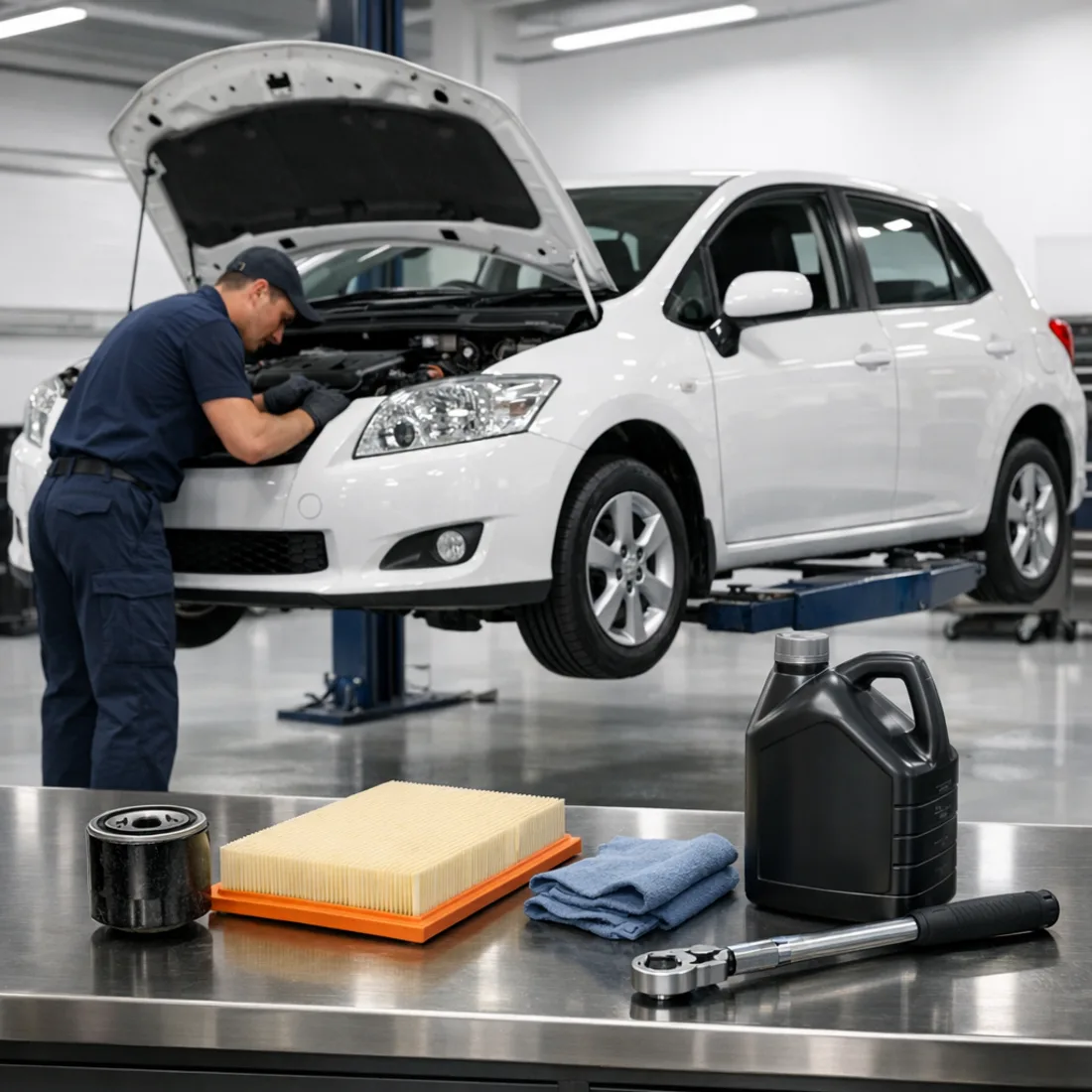
Regular servicing on the 1AD FTV is not complicated, but it does need to be done right. The oil choice matters more than on most diesels because of the DPF. We use a full synthetic diesel oil that meets or exceeds the factory low SAPS specification every time, no shortcuts. Beyond the oil and filter, a thorough service on this car covers the air filter, fuel filter, cabin filter, wiper blades and the drive belt. Glow plugs are often overlooked until one fails and cold starting becomes a lottery: we check them and replace them as a set when they're due rather than waiting for a hard start complaint in the middle of winter. Our full car servicing covers all of this in one visit, with everything logged so there are no gaps in the record.
Brake wear on the E15 Corolla is pretty straightforward, but a diesel that does a lot of motorway cruising can mask how worn the fronts are because the regenerative braking loads are different from a stop start commuter. We measure pad thickness and rotor condition at every service. When the rotors have worn past minimum thickness or show lipping and hard spots, we replace them properly rather than just swapping pads over worn metal. Brake repairs and replacement are a standard part of what we do, and we stock quality parts for the E15 platform.
How We Actually Diagnose These Cars
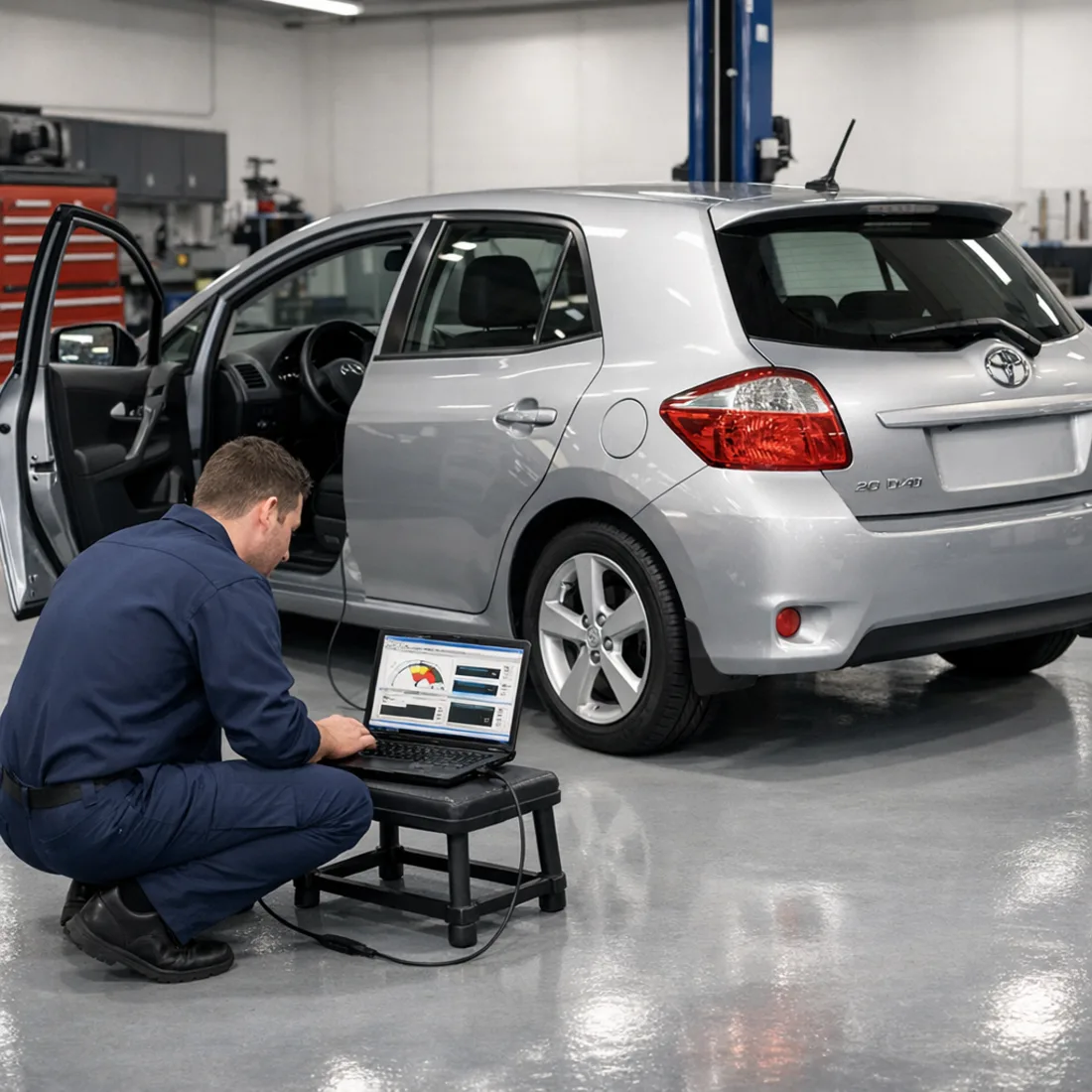
A generic OBD reader will pull a fault code off the 1AD FTV and give you a number. That's about as useful as a weather forecast that just says "weather". What you actually need is Toyota Techstream, the genuine factory diagnostic platform, connected through the correct interface. Techstream lets us command actuator tests on the EGR valve, the turbo actuator and the swirl flaps so we can see in real time whether a component is responding correctly or just registering as present. We can watch live boost pressure data against the MAP sensor reading, check injection quantity corrections per cylinder, review freeze frame data at the point a fault was logged, and run a full DPF status report including soot loading and regeneration history. That's the difference between fixing the actual fault and replacing parts until something changes.
At higher mileages the intake swirl flaps on the 1AD FTV can develop play in their spindles. Worst case, a flap detaches and goes straight into the engine. That is an extremely bad day. We inspect the swirl flap condition during any major service or diagnostic appointment and note it if the spindles show wear. Boost pressure irregularities, particularly a slow or lazy turbo response, usually point to the variable geometry turbo actuator sticking or the actuator calibration drifting. Techstream lets us test the actuator through its full range and check the feedback position sensor, so we know whether it needs cleaning, recalibration or replacement.
Stage 1 Tune: Finding What the 1AD FTV Was Holding Back
The 1AD FTV leaves a meaningful amount of performance on the table from the factory. Toyota calibrates these engines conservatively, partly for emissions compliance and partly for broad market reliability across variable fuel quality. Our Stage 1 calibration works within the hardware's real limits, adjusting fuelling, boost and timing parameters to extract what the engine is actually capable of. In practice that translates to noticeably stronger mid range pull, a flatter torque curve and less gear hunting on motorway overtakes. The engine does not feel stressed at these numbers because it was always capable of them; the factory tune was simply conservative.
The tune is delivered as a custom file written for the specific vehicle, not an off the shelf map flashed in generically. We also offer EGR off and DPF off calibrations for vehicles operated exclusively off road, alongside DTC removal where appropriate. These are documented honestly: they are for off road and track use, and fitting them to a road registered vehicle affects WOF compliance.
If you want to understand the process before committing, our tuning power gains page covers the detail. Custom file service is also available for this platform.
Frequently Asked Questions
The questions we get most. Something else on your mind? Get in touch.