T Roc 1.5 TSI: Servicing, Repairs and Tuning in New Zealand
The T Roc arrived in New Zealand showrooms wearing a confidence that few compact SUVs manage to pull off. Sharp looks, a genuinely involving drive, and the kind of badge recognition that keeps residuals healthy. Under that sculpted bonnet sits Volkswagen's 1.5 TSI EA211 evo, a four cylinder petrol unit that punches out 150 horsepower and does so with real refinement most of the time. The trouble is, "most of the time" is doing a lot of work in that sentence. Like any clever modern engine, the EA211 evo rewards attentive ownership and punishes neglect in ways that are sometimes subtle and occasionally expensive. We have had plenty of these through the workshop, and the patterns are consistent enough to be worth knowing before a small issue turns into a large bill.

The 1.5 TSI EA211 Evo: What Makes It Tick
The EA211 evo is one of the more sophisticated small petrol engines in the VW Group stable. It uses cylinder deactivation, which Volkswagen calls Active Cylinder Technology, shutting down two of the four cylinders under light load to save fuel. On paper that is clever engineering. In practice it means there are additional actuators and control systems that a conventional engine simply does not have.
The engine also breathes through a turbocharger and uses direct injection, which creates a specific long term weakness we will get to shortly. The cambelt on this family runs in an oil bath rather than dry, which is a different service proposition from what many owners expect. Get that detail wrong and the consequences go well beyond a snapped belt.
-
Low speed hesitation or kangaroo style surging at parking lot speeds and during gentle acceleration from rest, caused by outdated engine management calibration rather than mechanical failure. Volkswagen addressed this with software updates.
-
Active Cylinder Technology actuators playing up, causing the engine to not deactivate cylinders cleanly and resulting in rough running, an uneven idle, or an intermittent misfire feel. A generic scan tool often captures nothing useful; live data from the actual actuator circuits is required.
-
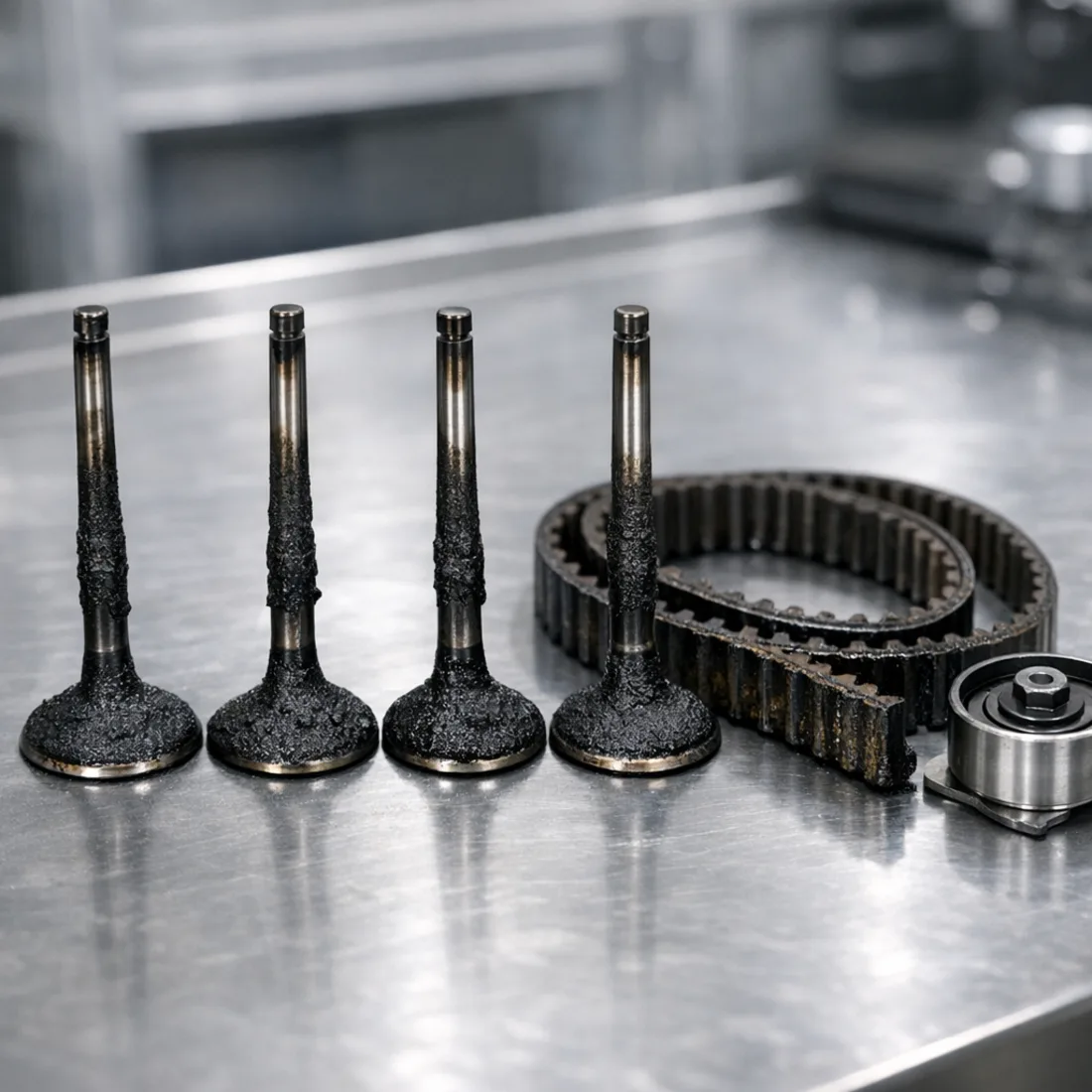
Carbon build up on the intake valves on higher mileage cars, a known consequence of direct injection. Symptoms include a rough cold start, reduced throttle response, and eventually a misfire code.
-
Oil bath cambelt wear from incorrect oil grade or stretched service intervals. Unlike a dry belt, a worn oil bath cambelt does not telegraph distress with squealing. It simply fails.
A worn oil bath cambelt does not telegraph its distress with squealing the way a dry belt might. It simply fails.
Staying on top of the correct oil and the correct belt inspection interval is not optional on this engine.
The most common complaint on early 1.5 TSI T Rocs is a low speed hesitation or a kangaroo style surging at parking lot speeds and during gentle acceleration from rest. It feels like the engine cannot decide what it wants to do, and it is disconcerting even if it is not immediately dangerous. The root cause in most cases is the engine management calibration rather than a mechanical failure, and Volkswagen addressed it with software updates. If your T Roc still has its original calibration and has never had that update applied, it is worth confirming, because driving around on outdated software is a bit like running a modern laptop on a five year old operating system.
Carbon build up on the intake valves is a known consequence of direct injection on higher mileage cars. In a port injected engine the fuel spray washes the back of the valves on every cycle. Direct injection bypasses the valves entirely, so any oil vapour from the crankcase ventilation system bakes onto the valve stems and seats over time. The symptom is a rough cold start, reduced throttle response, and eventually a misfire code. On a T Roc with serious kilometres it is worth an inspection. We use ODIS, the factory level VW Group diagnostic platform, to read live data from the actuators responsible for cylinder deactivation, verify whether the current software calibration matches the latest VW release, and check for stored and intermittent faults across every module in the car rather than just the engine control unit.
Get your T Roc booked in with a specialist who knows the EA211 evo inside out.
Oil, Filters and the Cambelt
The 1.5 TSI calls for a fully synthetic oil that meets the VW 508.00 or 504.00 specification, depending on the service interval type your car is set up for. Using an oil that does not meet those standards is not a minor oversight on this engine. It directly affects the condition of the oil bath cambelt housing, the lubrication of the actuators, and the long term health of the turbocharger. We fit the correct grade every time and confirm the specification against the build code before we drain a drop.
The air filter, cabin filter, and fuel system are all straightforward items that we service on schedule, and the spark plugs are due at the manufacturer's recommended interval rather than whenever they look worn. The T Roc is not a heavy car, but it is a quick one, and the braking system works accordingly. We inspect the pads and rotors at every service visit and replace them as a set when the time comes, because a new pad on a worn rotor gives you neither the feel nor the stopping distance you are paying for. Our brake repair service covers it in detail. Suspension components, including bushes, drop links, and wheel bearings, are worth checking on any T Roc that has seen a few New Zealand winters and the road surfaces that come with them.

How We Actually Diagnose a T Roc
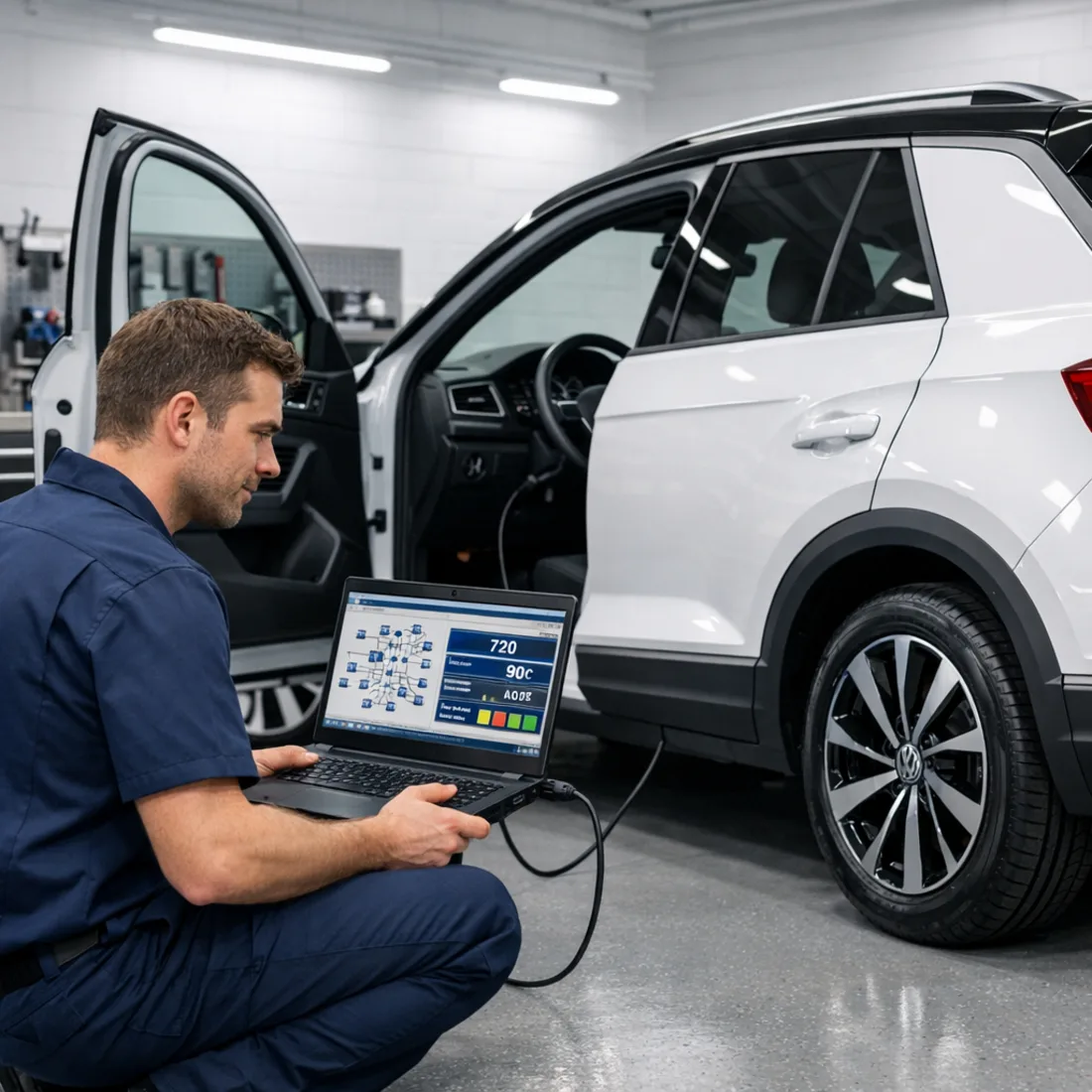
Generic scan tools read generic faults. That is fine for reading a tyre pressure warning, but it is not sufficient for an engine with Active Cylinder Technology, adaptive software calibrations, and a network of control modules that talk to each other constantly. We use ODIS, the factory level VW Group diagnostic platform, which is the same system the dealer technicians use. ODIS lets us read live data from the actuators responsible for cylinder deactivation, verify whether the current software calibration matches the latest VW release, and check for stored and intermittent faults across every module in the car rather than just the engine control unit.
That distinction matters in practice. The low speed surging fault mentioned above might store no fault code at all on a generic reader, because from a basic sensor perspective nothing is technically wrong. ODIS can show us whether the calibration version is superseded and allow us to apply the current release. For the intake valve carbon issue, diagnosis involves combining fault data with a physical inspection rather than guessing from a code alone. We root cause the problem before recommending a repair, which saves you money and saves us the embarrassment of replacing parts that were not the issue. Modern Volkswagen Group vehicles also require component coding into the vehicle network after replacement; a replacement sensor, control module, or even a battery on some variants requires a coding procedure to function correctly, and we handle this through ODIS rather than workarounds.
Stage 1 Tuning: More From What Is Already There
The 1.5 TSI was designed with some headroom in the calibration. Stage 1 tuning remaps the engine control unit to use that headroom, sharpening throttle response and lifting power and torque beyond the factory figures without any hardware changes. For a daily driver this means a noticeably more willing engine at motorway speeds and less need to drop a gear for overtaking.
The EA211 evo responds well to a quality calibration from someone who knows the platform. It is worth noting that the tuning also makes the cylinder deactivation system work more cleanly in some cases, because the engine spends less time in the awkward low torque zone where the transition between four and two cylinder modes can feel abrupt. We do not sell tuning as a miracle cure and we do not quote numbers we cannot back up.
We offer Stage 1 tuning for the T Roc 1.5 TSI as a standalone service or as part of a full service visit. Our performance tuning page explains the process and what realistic gains look like on this engine.
Frequently Asked Questions
The questions we get most. Something else on your mind? Get in touch.