VW Transporter T4, T5 & T6 Service, Repairs & Diagnostics
The Transporter story stretches from a chunky five cylinder workhorse that refuses to die, through the common rail T5 facelift, into the biturbo EA288 T6, and finally to the T6.1's petrol option. Each generation fixed some things, introduced others, and all of them end up on our hoist in Penrose for the same reason: they work hard and they need someone who actually knows them. This page covers all four variants, what goes wrong at which mileage, how the generations compare, and what to look for if you're shopping used.
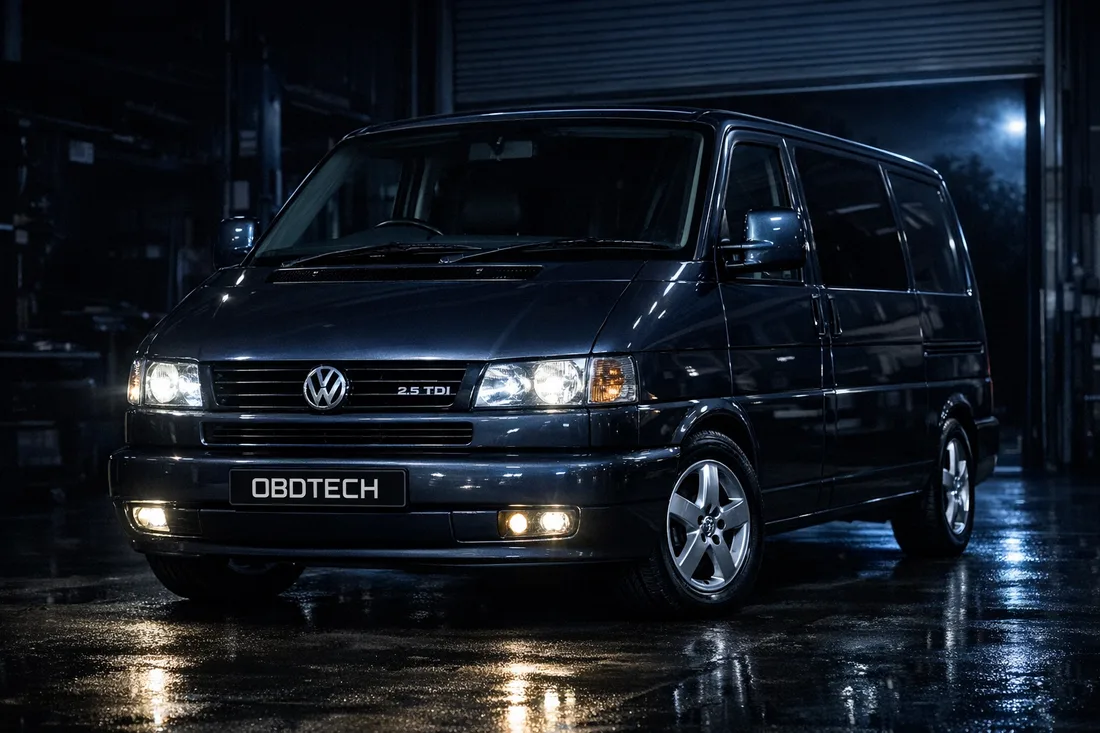



Volkswagen Transporter T4 2.5 TDI 88hp (AJT): The Van That Refuses to Die
You still see T4s everywhere in Auckland. Builders' yards, surf trips, weekend markets, small fleets running them well past 300,000 km. The five cylinder 2.5 TDI with the AJT engine code displaces 2461 cc, makes 88 hp and 195 Nm, runs a 19.5:1 compression ratio, and is managed by a Bosch EDC15VM+ ECU. It earns its reputation, but robust does not mean bulletproof. These vans have age related failure points that are very predictable once you've seen enough of them.
The biggest mechanical priority on any T4 TDI is the cambelt. Timing is by belt, not chain, and on high mileage vans the belt interval is often unknown or long overdue. A snapped belt on this engine is an engine. Don't gamble on it. While the belt is off, do the tensioner and water pump at the same time.
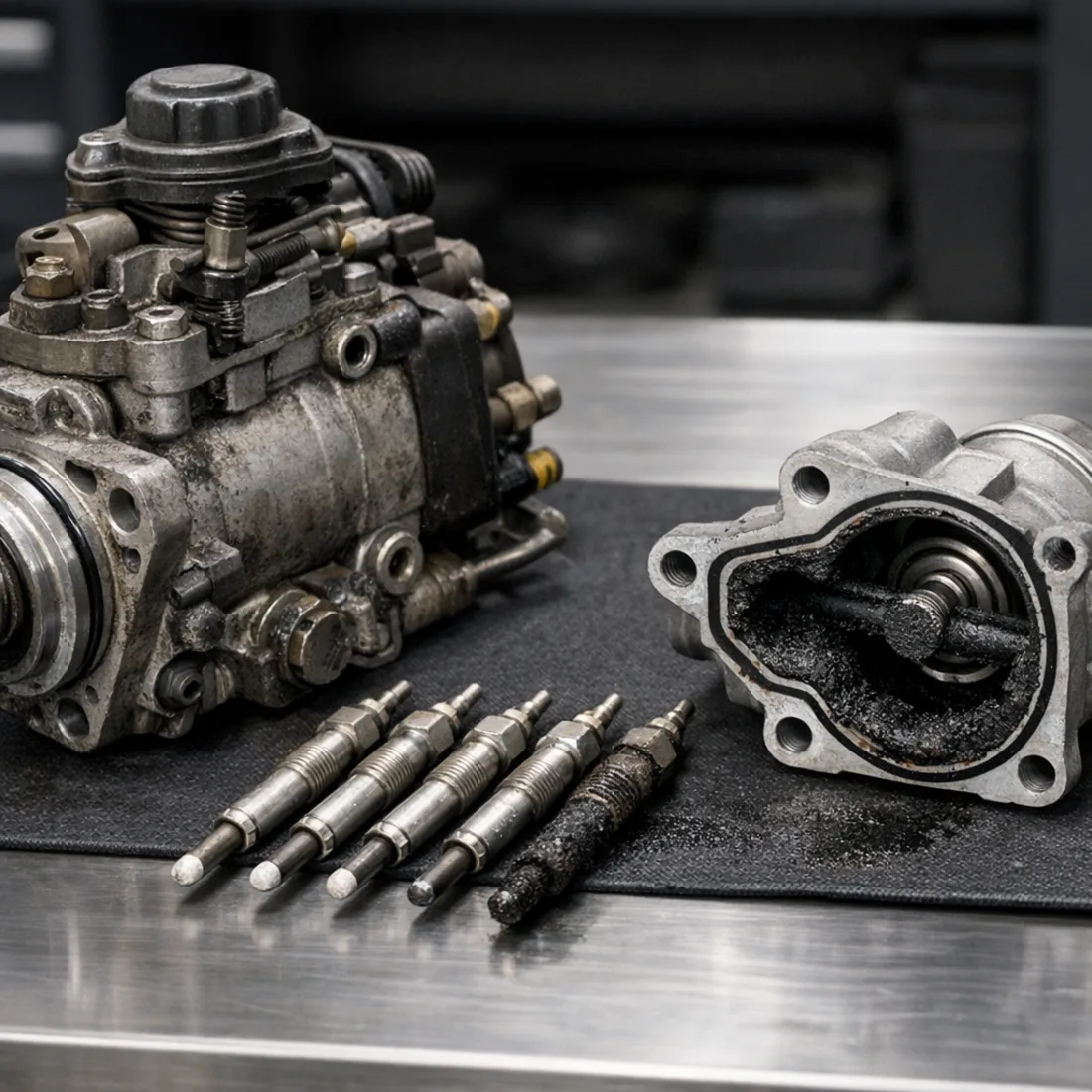
The injection pump is a distributor type VE unit and it does wear. Symptoms are slow starting, white smoke when cold, and rough fuelling at idle. The wiring to the pump is also prone to age related faults that a generic code reader won't diagnose properly. We use factory VW ODIS to pull live injection data from the EDC15VM+ so we're reading actual pump and fuelling figures, not guessing.
The T4 predates the T5's common rail fuel system, so it doesn't share the DPF and swirl flap headaches of the later vans. That's actually an advantage on a high mileage working vehicle. What you're managing here is age and kilometres, not emissions hardware complexity.
-
VE injection pump wear and wiring faults affecting starting and fuelling
-
Tandem pump seal failure causing oil contamination
-
Injector wear leading to smoke and rough running
-
Cambelt and tensioner failure risk on unknown history vans
-
Turbo carbon build up reducing boost
-
EGR valve clogging causing rough idle and lumpy running
-
Glow plug failure making cold starts difficult
A snapped belt on this engine is an engine.
If cambelt history is unknown, treat it as overdue and book it in before anything else.
Routine servicing on the T4 includes oil and filter with the correct diesel grade, fuel filter, air filter, cabin filter, drive belts and glow plugs. On the mechanical side we do EGR cleaning, clutch replacement, suspension bushes and brake pads and rotors.
If you want a bit more grunt from the AJT, a Stage 1 remap lifts output to 115 hp and 240 Nm, which is a genuine improvement for a loaded van.
Get your Transporter booked in with a proper specialist.
Volkswagen Transporter T5 2.0 TDI CR 140hp (CAAC): The Common Rail Step Forward
The facelift T5 ditched the older pump duse PD engines in favour of a 2.0 TDI common rail unit. The CAAC engine code is the one we see most, producing 140 hp and 340 Nm from a 1968 cc block with an 81.0 x 95.5 mm bore and stroke, a 16.0:1 compression ratio, and a Bosch EDC17CP20 ECU. On paper it was cleaner, quieter and more efficient than the PD. In practice it brought a new set of problems alongside those gains.
The common rail system runs at much higher fuel pressures than the old VE pump, so injector and high pressure fuel pump health is a bigger deal. These can be a costly failure, and it's worth checking fuel quality history on any used T5 you're considering. Contaminated fuel is brutal on a common rail system.
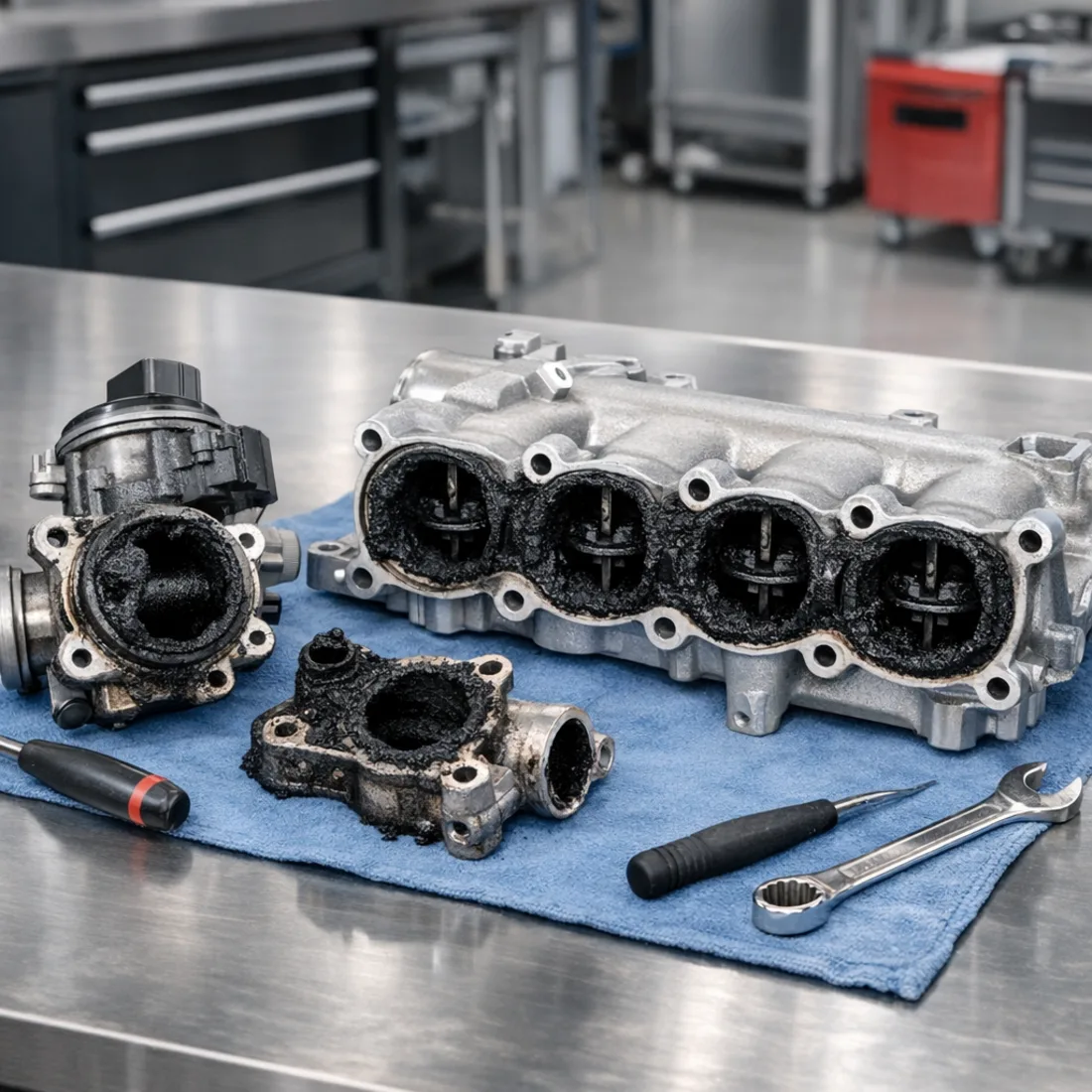
The EGR and intake carbon situation on the T5 CAAC is noticeably worse than the T4 it replaced. The combination of EGR gases, oil mist and stop start urban work loads deposits a thick layer of carbon on the intake manifold and swirl flaps. Left long enough it causes misfires, rough idle, fault codes and poor throttle response. This is a clean and inspect job we do regularly at our workshop, and it's worth budgeting for on any T5 with significant urban kilometres.
The DPF is the other recurring theme. Vans doing short runs never get long enough at temperature to regenerate properly, so the filter loads up. Aggressive driving to force a regen isn't always practical in a work van. We do DPF cleaning where appropriate and diagnose the full regeneration system to find whether the issue is the filter itself, a sensor, or a software fault.
Timing on the T5 CAAC is by cambelt, same as the T4, so that service interval isn't something to stretch. We replace the belt, tensioner and water pump together. On the gearbox side, dual mass flywheel wear is common at higher mileage. It presents as judder on take off or a harsh clunk when pulling away. We can quote a clutch and dual mass package when the vehicle's on the hoist.
-
EGR valve clogging and associated intake manifold carbon build up
-
Swirl flap carbon fouling causing rough running and fault codes
-
DPF blockage from short stop start delivery and urban work cycles
-
High pressure fuel pump and injector wear at higher mileage
-
Dual mass flywheel wear on hard working or high mileage examples
-
Cambelt and water pump, which must be replaced at the correct interval
For owners who want more from the CAAC, our Stage 1 tune takes it to 180 hp and 410 Nm.
A gain of 40 hp and 70 Nm over stock, a meaningful difference in a loaded van or Multivan.
We diagnose all T5s with factory ODIS, not a generic reader, so we get live data, guided fault finding and correct service resets from the EDC17CP20. On the T5 CAAC with its EDC17CP20, we can run guided tests on the EGR system, watch DPF differential pressure in real time and see injector correction values.
Our full vehicle servicing covers the T5 with generation specific fluids, filters and intervals, and Stage 1 tuning is available to unlock the CAAC's full potential for highway or loaded work.
Volkswagen Transporter T6 2.0 TDI 204hp: The Biturbo That Works Hardest of All
The T6 brought the EA288 engine family and the 204hp biturbo diesel is the pick of the diesel range. Same 1968 cc displacement and 81.0 x 95.5 mm bore and stroke as the T5, but with twin turbos and a remap, it produces 204 hp and 450 Nm stock. That's a serious amount of torque in a van, and it earns its keep pulling loaded Multivans, camper conversions, and airport shuttle runs every day. It also means it's working harder than most engines its size, and it needs to be maintained accordingly.
The EA288 fixed some of the T5's specific faults but brought its own considerations. Compared to the CAAC in the T5, the EA288 adds AdBlue SCR emissions hardware into the mix. That system causes limp mode when it faults, and it faults more often than owners expect. We check the full AdBlue and NOx dosing system properly, not just the warning light.
The AdBlue system is worth understanding before you buy a T6. When it faults it will limit the number of starts available and eventually force the van into a derated mode. It's not a system you can ignore. We diagnose these correctly with factory ODIS, which is the only way to properly interrogate the NOx sensor data, dosing pump function and SCR catalyst efficiency on an EA288.
The T6 switched from a cambelt to a timing chain, which removes one of the major service anxiety items from the T4 and T5. That's a genuine improvement. However, the balance shaft and oil pump chain drive on higher mileage EA288 engines is worth inspecting. It's not a common failure but it's a significant one when it does go. Regular oil changes with the correct low SAPS long life grade are the best insurance.
Braking is a bigger conversation on a loaded T6 than on the lighter T4. Front and rear pads and rotors wear faster under commercial loads, and we check them every service. Our brake inspection and repair service covers the full system including calipers and brake fluid condition.
-
EGR valve clogging and EGR cooler faults causing overheating or fault codes
-
DPF blockage from low speed urban cycles, same pattern as the T5 but with more sensors to watch
-
AdBlue SCR dosing errors and NOx sensor faults triggering limp mode
-
Turbo actuator faults on the variable geometry or biturbo system
-
Balance shaft and oil pump chain drive wear on higher mileage examples
-
Injector wear showing up as rough running or smoke at higher mileage
When the AdBlue system faults it will limit the number of starts available and eventually force the van into a derated mode.
It's not a system you can ignore. We diagnose these correctly with factory ODIS.
The Stage 1 tune on the T6 204hp takes it to 240 hp and 520 Nm, gains of 36 hp and 70 Nm. For a camper or a heavily loaded Multivan that extra torque makes daily driving considerably less stressful.
We can also look at DSG servicing on T6s with the automatic gearbox, and handle all programming and coding work through ODIS including control module adaptations after repairs.
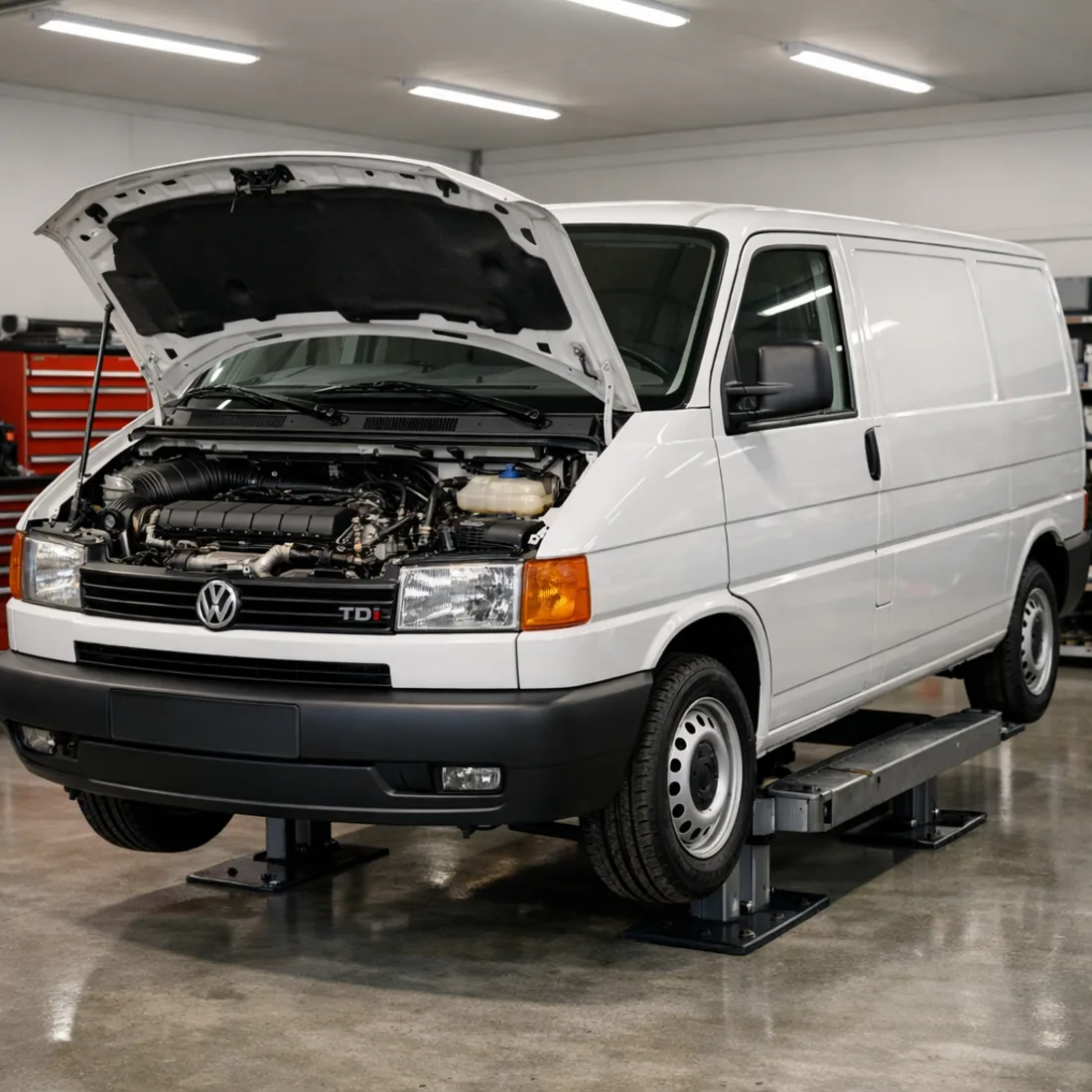
Volkswagen Transporter T6.1 1.5 TSI 136hp: The Petrol Option Changes the Game
The T6.1 introduced something genuinely new to the Transporter line: a petrol engine as a mainstream option. The 1.5 TSI EA211 evo produces 136 hp and is chain driven, which already puts it ahead of the T4 and T5 on the timing belt anxiety front. For owners who do longer highway runs or who just prefer petrol, this van makes a lot of sense. But it has its own specific fault patterns, and they're quite different from the diesel generations.
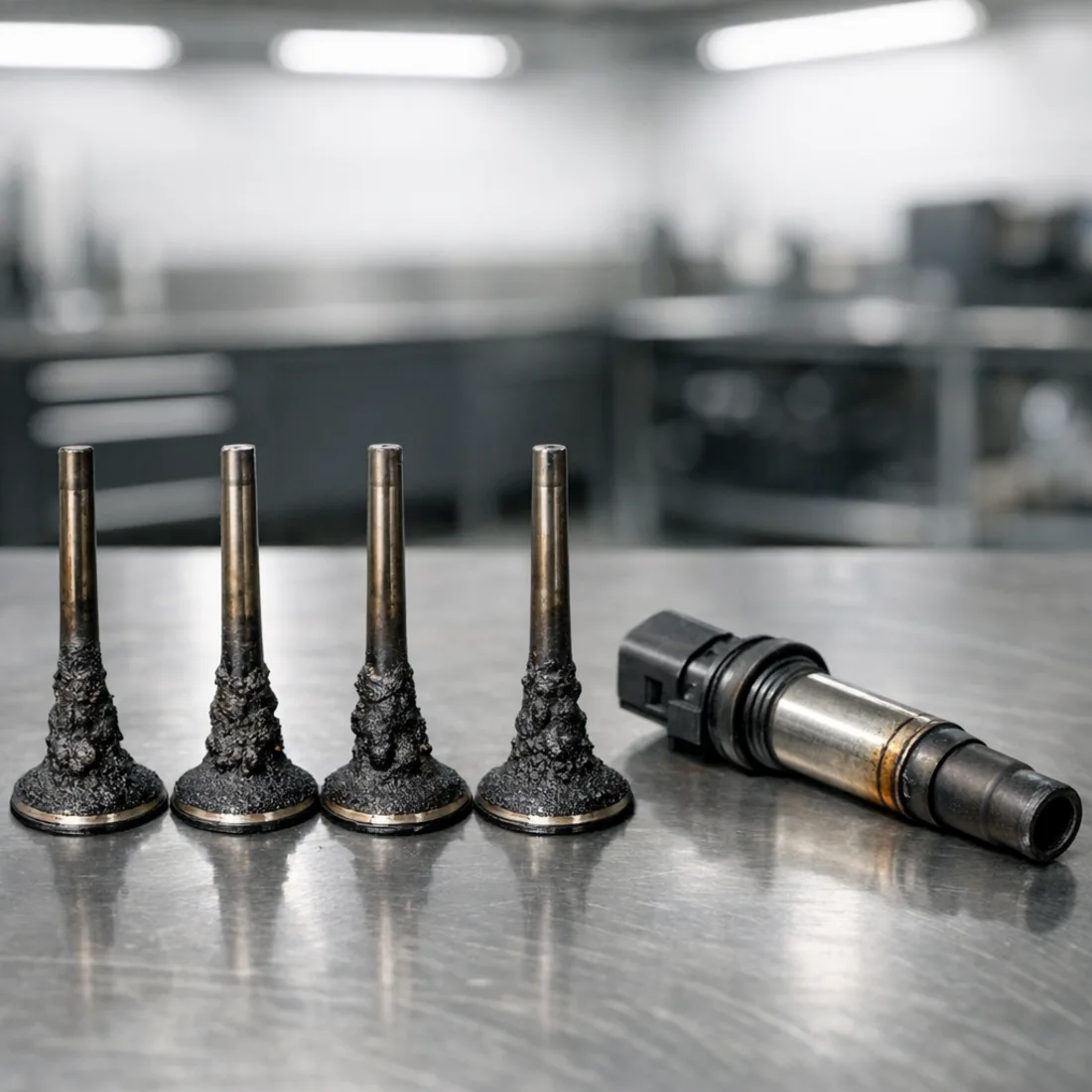
The EA211 evo uses direct injection, which means carbon build up on the intake valves over time. There's no fuel washing over the valves on a direct injection engine, so carbon deposits accumulate. The T5 diesel had the same issue in the intake manifold, but on the TSI it shows up on the valves themselves and requires a different approach to clean. At higher mileage it causes rough running, hesitation and reduced power.
The Active Cylinder Technology on the EA211 evo deactivates two cylinders under light load to save fuel. Some owners report a slight jerkiness or hesitation at low speed during cylinder transitions. This is often a software calibration issue rather than a mechanical one, and factory ODIS gives us the tools to read the live cylinder activation data and assess whether it's within normal parameters or pointing to a fault.
Water pump and thermostat housing seepage is worth watching on the T6.1 TSI. It doesn't tend to cause dramatic failures but coolant loss over time can creep up on you. We check the cooling system pressure on every service. Ignition coils and spark plugs are standard petrol wear items and on a working van that does serious kilometres they need attention before they cause a misfire that sets off a cascade of fault codes.
Compared to the T6 diesel, the T6.1 TSI avoids the AdBlue system entirely, which is a real world simplification. No dosing pump, no NOx sensor, no limp mode countdown. If emissions hardware complexity is something you want to avoid, the petrol T6.1 is the cleanest option in the range from a maintenance perspective. What you trade is the diesel's torque advantage when loaded.
-
Intake valve carbon build up from direct injection, especially above higher mileage
-
Low speed hesitation or jerkiness linked to Active Cylinder Technology and software mapping
-
Water pump and thermostat housing coolant seepage
-
Ignition coil and spark plug wear causing misfires if intervals are stretched
The T6.1 TSI avoids the AdBlue system entirely. No dosing pump, no NOx sensor, no limp mode countdown.
If emissions hardware complexity is something you want to avoid, this is the cleanest option in the range from a maintenance perspective.
Routine servicing on the 1.5 TSI uses VW 508 or 504 approved oil, air filter, cabin filter, fresh spark plugs, wipers and drive belt inspection. Stage 1 tuning is available to increase torque for towing or loaded use.
We run all T6.1 diagnostics on factory ODIS for correct live data reading and coding after any repairs.
Which Transporter Generation Makes the Most Sense?
If you're shopping the Transporter market and trying to choose between generations, here's how we'd frame it from what we actually see in the workshop. Across all generations, the most important buying advice is simple: get it properly diagnosed before you buy. A factory ODIS scan will tell you things a visual inspection won't, and it can save you from someone else's deferred maintenance bill.
You want the simplest possible van with no DPF, no swirl flaps and no AdBlue. The AJT injection pump and cambelt are the things to sort early, and once done a T4 will run for a long time. Budget purchase, manageable maintenance, genuine workhorse. Check cambelt history before anything else.
You want the sweet spot for many used buyers. Common rail diesel means better fuel economy than the T4, and there's good parts and knowledge availability now. EGR, intake carbon and DPF cleaning are the recurring costs. If the previous owner did short urban runs, budget for a thorough intake clean early.
You need the most capable diesel and are prepared for the most complex one. AdBlue hardware adds a failure mode the earlier vans don't have. Buy one with full service history and known AdBlue maintenance. The power and torque are worth it for heavy use, but it needs proper attention to earn that.
You do mixed or highway driving and want to avoid diesel emissions complexity altogether. It's the newest and simplest from an emissions hardware standpoint, but direct injection carbon build up is a thing to watch, and it doesn't have the diesel's torque advantage when loaded.
- Check cambelt history on T4 and T5 before anything else
- On T5, budget for intake manifold and EGR carbon clean if urban kilometres are high
- On T6, confirm full AdBlue and SCR service history before purchase
- Check fuel quality history on any used T5 common rail van
- Inspect DPF condition on all diesel variants, especially delivery or urban use examples
- Check for dual mass flywheel judder on T5 examples with high mileage
- On T6.1 TSI, check for intake valve carbon at higher mileage
- Get a factory ODIS scan done before you buy any generation
Servicing Across the Transporter Family
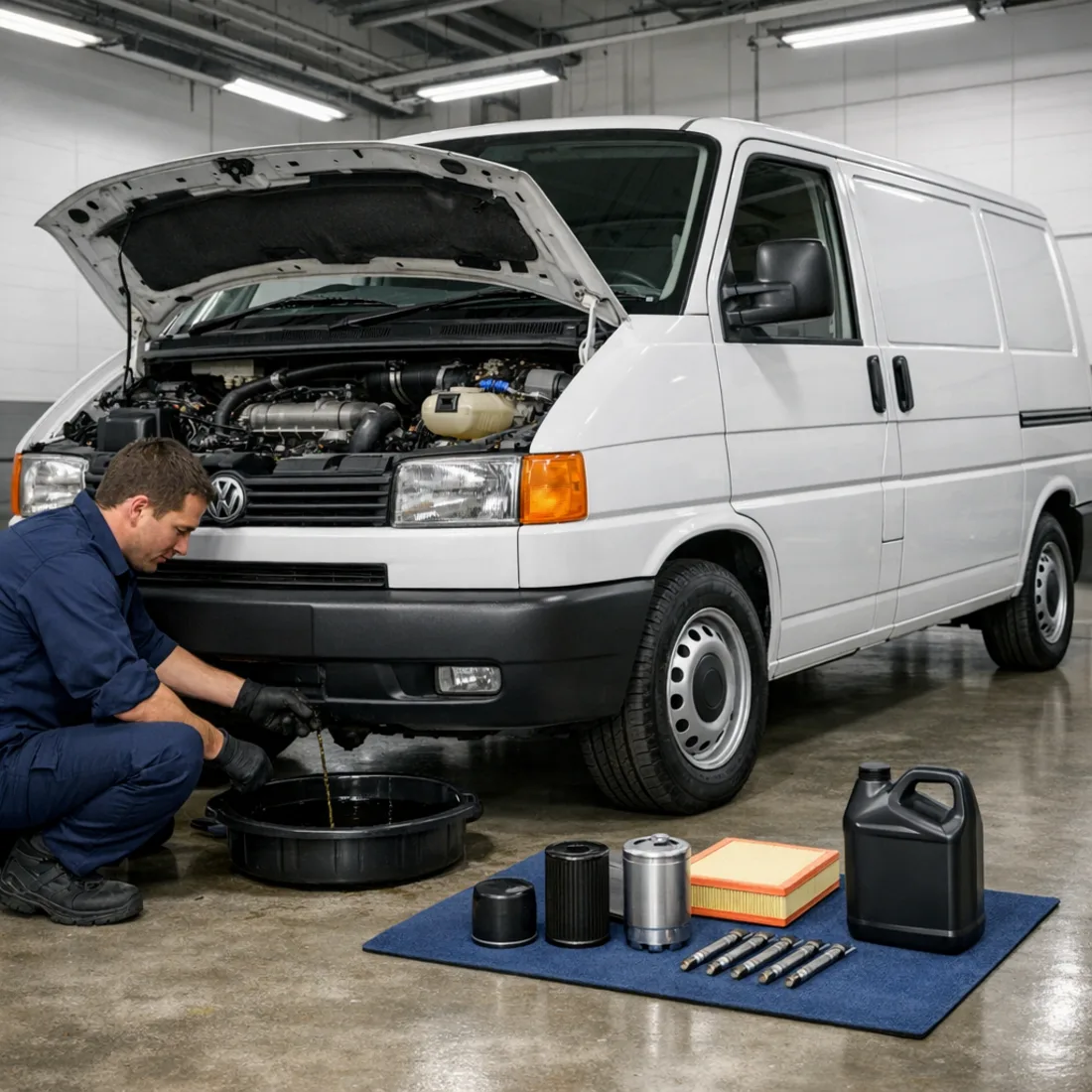
Every generation has its own service intervals and fluid specifications, and getting them right matters. The T4 AJT runs a conventional diesel engine oil grade. The T5 CAAC and T6 EA288 diesels both need a low SAPS oil that protects the DPF. The T6.1 TSI needs VW 508 or 504 approved oil for the EA211 evo's extended drain intervals. Using the wrong oil grade on any of these engines causes real damage over time.
Our full vehicle servicing covers all four generations with generation specific fluids, filters and intervals. A typical Transporter service with us includes engine oil and filter using the correct VW spec grade for that engine, air filter, fuel filter on diesels, cabin filter, spark plugs on the TSI, glow plugs on the diesels as needed, drive belt and accessory belt inspection, cambelt and water pump on T4 and T5 at correct intervals, brake pad and rotor check and replacement where due, suspension and steering inspection under load, and a factory ODIS diagnostic scan to catch anything the service light hasn't reported yet.
We fit brand new genuine and OEM spec parts only. No shortcuts there. And we reset service intervals correctly through ODIS so the van's service counter reflects what was actually done.
How We Diagnose These Vans: Factory ODIS, Not Generic Guessing
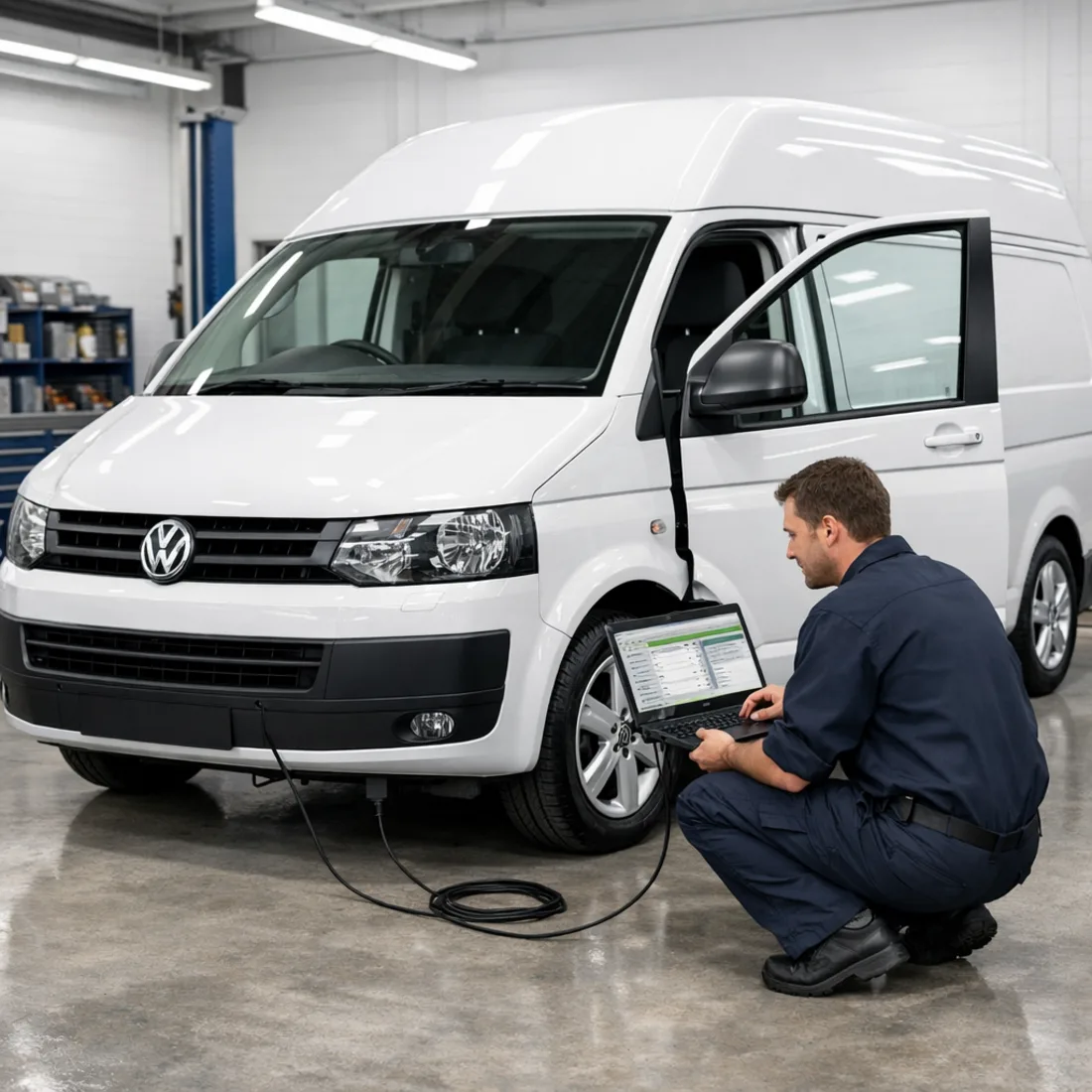
The single biggest difference between what we do and what a lot of general workshops offer is the diagnostic platform. Every generation of Transporter, from the T4 AJT with its Bosch EDC15VM+ right through to the T6.1's EA211 evo, is diagnosed using the factory VW ODIS platform. Generic OBD readers give you fault codes. ODIS gives you live data, guided fault finding, component testing and the ability to code correctly after repairs.
On the T4, ODIS lets us read live injection pump data from the EDC15VM+ that tells us about fuel delivery and pump health, not just what's stored in memory. On the T5 CAAC with its EDC17CP20, we can run guided tests on the EGR system, watch DPF differential pressure in real time and see injector correction values. On the T6 EA288 the AdBlue and NOx system requires factory level access to read dosing pump feedback and SCR efficiency properly. On the T6.1 TSI it lets us monitor live cylinder activation data for the Active Cylinder Technology and code coil packs and sensors correctly.
We also handle all programming and coding work through ODIS, including control module adaptations after repairs. If you need key programming or immobiliser work on any Transporter generation, our auto electricians cover that properly with factory tooling.
Tuning and Performance Work Across the Range
All four generations have tuning options available where the notes support it. All tuning work is done with a proper flash through the factory ECU interface, not a piggyback device. We also do EGR and DPF system diagnostics and cleaning where appropriate across the diesel range.
Useful low end torque gain for a loaded or towing van. The remap works within the hardware's safe limits and transforms drivability for a vehicle that often runs close to its payload limit.
A 40 hp and 70 Nm gain that transforms the van's highway ability. A meaningful difference in a loaded van or Multivan, and one of the most popular tunes we do on the Transporter range.
Already the most powerful diesel in the range, the remap adds 36 hp and 70 Nm on top. For a camper or heavily loaded Multivan that extra torque makes daily driving considerably less stressful.
Stage 1 tuning is available on the EA211 evo to improve torque for loaded or towing use, where the petrol's natural torque deficit versus the diesel range is most noticeable.
If you want to know what's possible on your specific van, have a look at our performance tuning options or just bring it in and we'll talk through what makes sense for how you use the vehicle.
Frequently Asked Questions
The questions we get most. Something else on your mind? Get in touch.